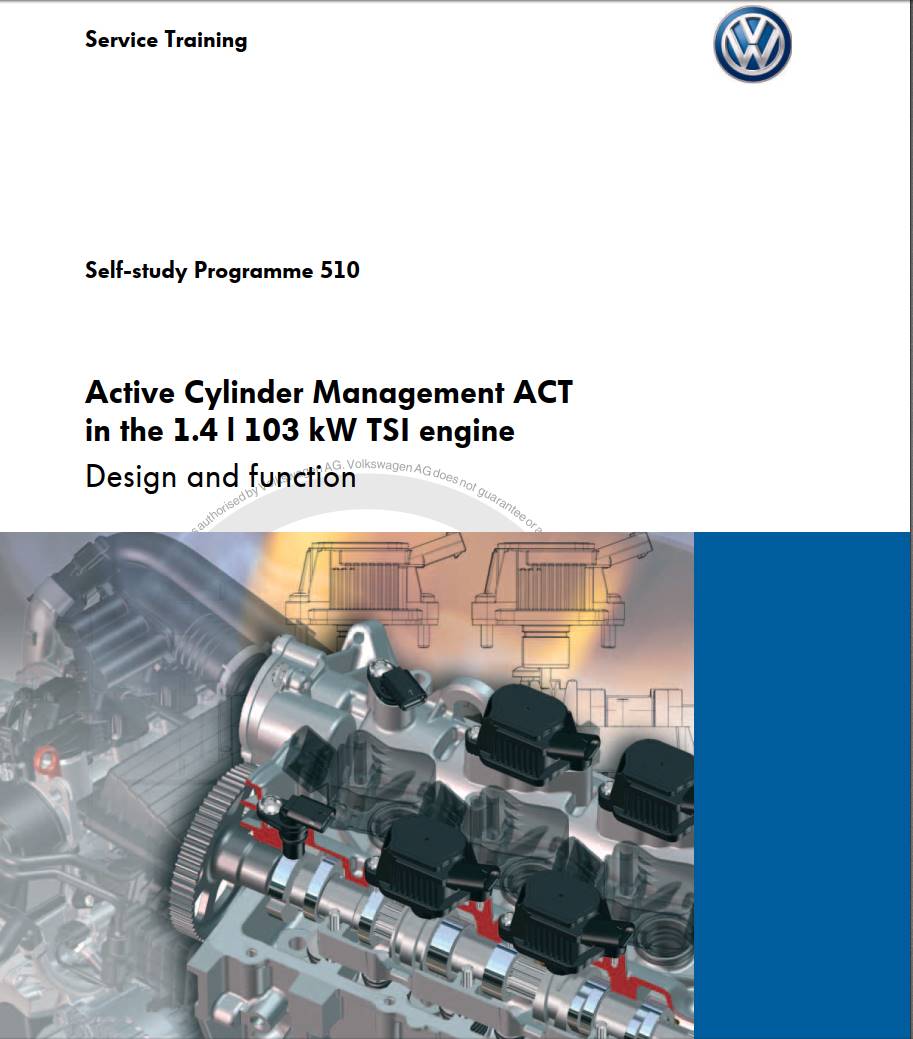
This comprehensive 34-page PDF file contains the official VAG Self-Study Program 510 (SSP 510), dedicated entirely to the design and function of the groundbreaking Active Cylinder Management (ACT) technology utilized in the 1.4-liter 103 kW TSI engine. As part of the EA211 modular petrol engine matrix (MOB), this specific engine variant was the very first high-volume turbocharged four-cylinder engine to feature cylinder deactivation, a technology previously reserved for large V8 or V12 engines. This technical training manual is an absolute must-have for VAG technicians, diagnostic specialists, and engineers who need to understand the incredibly complex mechanical and electronic coordination required to make this system operate imperceptibly to the driver.
Please note: As a Self-Study Program, this document focuses on engineering design, mechanical actuation, and operational theory. It is not a step-by-step repair or workshop manual, though the theoretical knowledge it provides is crucial for diagnosing valvetrain faults or engine management issues related to the ACT system.
This detailed technical training manual covers the following key engineering topics:
- System Overview and Operating Parameters: An introduction to the ACT philosophy. It explains the specific conditions under which the system activates (typically between 1,400 to 4,000 rpm and low load ranges) to deactivate cylinders 2 and 3, reducing charge exchange losses and improving fuel consumption by up to 20% during part-load operation.
- Mechanical Valvetrain Design: The core of the SSP. It meticulously breaks down the incredibly complex mechanical components required to disable the valves. It details the design of the splined camshafts, the sliding cam sleeves (cam pieces), and the electromagnetic actuators with metal pins that physically shift the sleeves onto “zero-lift” cam lobes, effectively keeping the valves closed.
- Engine Management and Actuation: A deep dive into the electronic “brain” controlling the system. It explains how the ECU coordinates the exact timing of the electromagnetic pin actuation (which must occur within half a camshaft revolution) while simultaneously adjusting fuel injection, ignition timing, and the electronic throttle body to ensure the transition between two-cylinder and four-cylinder modes is completely smooth and unnoticeable.
- System Diagnostics: The manual concludes with an overview of the specific sensors and engine management functions related to the ACT system, providing a foundation for troubleshooting valvetrain actuation faults.
Whether you are trying to understand the precise mechanical movement of the sliding cam pieces, diagnosing a fault code related to the camshaft actuators, or simply want to appreciate the incredible engineering behind 4-cylinder deactivation, SSP 510 is the definitive technical resource.
CONTENTS
- Introduction
- The 1.4 l 103 kW TSI engine with Active Cylinder Management ACT
- Advantages of Active Cylinder Management
- Engine mechanics
- Design of Active Cylinder Management
- Design of the camshafts
- Movement of the cam pieces
- Measures to reduce vibrations and noise
- Engine management
- System overview
- The engine management system
- Operating range of Active Cylinder Management ACT
- The deactivation process
- The activation process
- Display for Active Cylinder Management ACT
- Sensors
- Actuators
- Service
- Special tools
- Test your knowledge
Language: English
Format: PDF
Pages: 36