Wheel Bolt Pattern Lookup
Select a bolt pattern (PCD) to instantly see the stud count, pitch circle diameter in mm and inches, and common vehicle examples for wheel fitment.
Wheel Bolt Pattern Lookup
Select a PCD to see stud count, dimensions, and fitment examples
How It Works
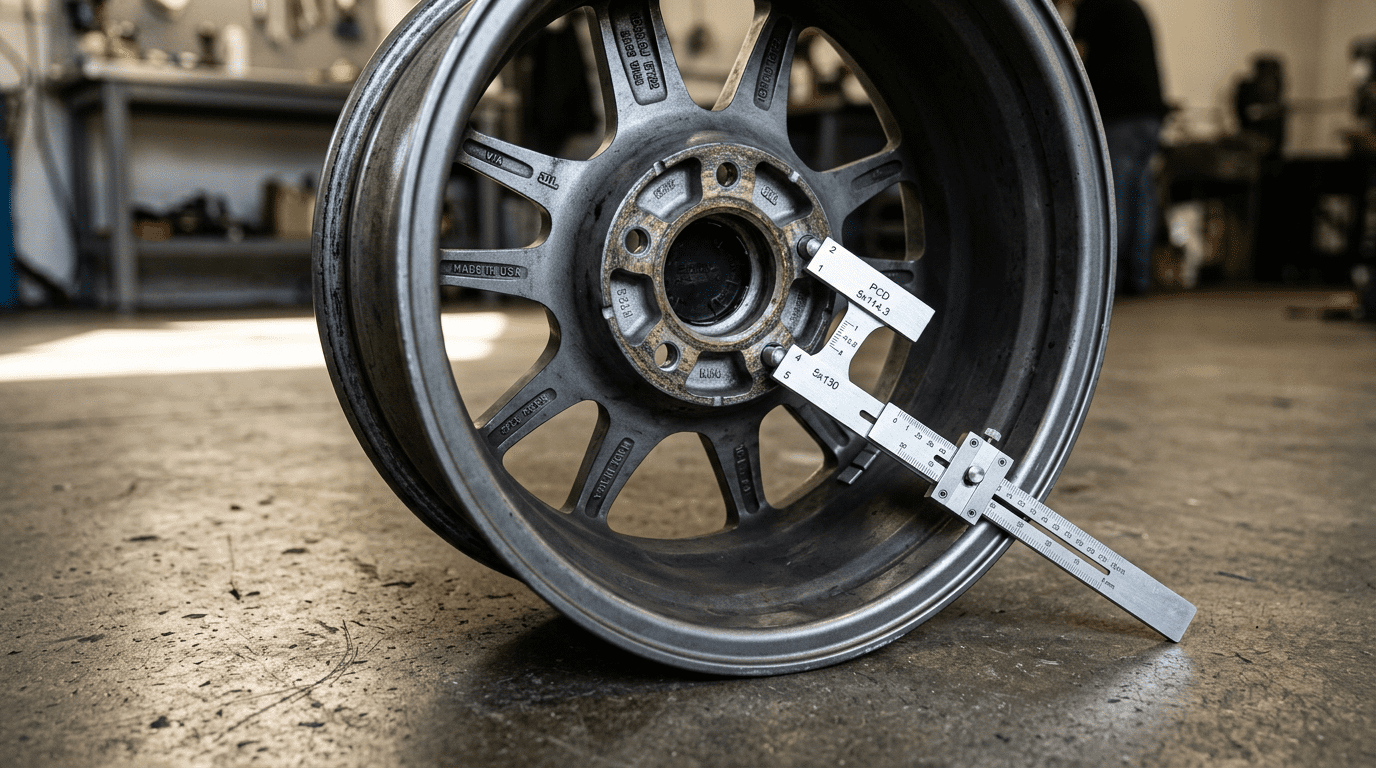
The bolt pattern (PCD — Pitch Circle Diameter) is described as Studs×Diameter. This tool looks up that pattern in an internal table and returns the stud count, PCD in both metric and imperial, and the most common fitment vehicles.
How to Use This Calculator
- Select your vehicle’s bolt pattern from the dropdown (e.g., 5×114.3).
- Click Look Up to see the PCD in mm and inches plus compatible vehicles.
- Compare with aftermarket wheel specs to confirm fitment compatibility.
- Remember that bolt pattern alone does not guarantee fitment — also verify hub bore, offset, and brake clearance.
- Use the reference table below to cross-reference make/model if you are unsure of your pattern.
Worked Example
Reference Table
| Pattern | Studs | PCD (mm) | PCD (in) | Common Vehicles |
|---|---|---|---|---|
| 4×100 | 4 | 100 | 3.937 | Honda Civic EG/EK, Mazda Miata, VW Golf Mk3 |
| 4×10⁸ | 4 | 108 | 4.252 | Ford Fiesta (classic), Peugeot 205 |
| 5×100 | 5 | 100 | 3.937 | Subaru WRX (to 2004), VW Golf Mk4, Audi TT 8N |
| 5×10⁸ | 5 | 108 | 4.252 | Ford Focus, Volvo S40, Peugeot 407 |
| 5×112 | 5 | 112 | 4.409 | Audi A4/A6, VW Passat/Tiguan, Mercedes C/E-Class |
| 5×114.3 | 5 | 114.3 | 4.500 | Toyota Camry/RAV4, Honda CR-V, Hyundai Sonata, Ford Mustang |
| 5×120 | 5 | 120 | 4.724 | BMW 3/5-Series, Land Rover, Chevrolet Camaro |
| 6×114.3 | 6 | 114.3 | 4.500 | Nissan Frontier/Pathfinder, Toyota 4Runner (older) |
| 6×139.7 | 6 | 139.7 | 5.500 | Toyota Tundra/Tacoma, Chevy Colorado, Nissan Patrol |
| 8×165.1 | 8 | 165.1 | 6.500 | GM 2500/3500 HD, RAM 2500/3500 (older) |
| 8×170 | 8 | 170 | 6.693 | Ford F-250/F-350 Super Duty |
Frequently Asked Questions
Does the same bolt pattern guarantee wheel fitment?
No. Bolt pattern is only one of four fitment criteria. You must also match the hub bore diameter (center hole), the offset (ET value in mm), and verify adequate brake caliper clearance. A wheel with the correct bolt pattern but wrong offset can cause handling problems or rub against the bodywork.
What is hub bore and why does it matter for wheel fitment?
The hub bore is the center hole in the wheel that slides over the vehicle’s axle hub. For a proper fit, the wheel’s center bore must be equal to or larger than the hub. If larger, hub-centric rings fill the gap and prevent vibration. Most aftermarket wheels are “lug-centric” and use the bolt pattern alone to center the wheel.
Can I use wheel spacers to change the bolt pattern?
Bolt pattern spacers (also called adapters) bolt onto the existing studs and provide a new bolt pattern. They are widely used but reduce the effective thread engagement on the original studs. Quality adapters from reputable brands are generally safe, but they add unsprung weight and alter the wheel offset.
How do I measure my bolt pattern without a tool?
For 4 and 6 stud wheels, measure directly across the center from stud center to stud center for opposite studs. For 5 stud wheels, measure from the center of one stud to the outside of the stud two positions away — this approximation is accurate enough to identify the pattern. A dedicated bolt pattern gauge gives the most precise reading.