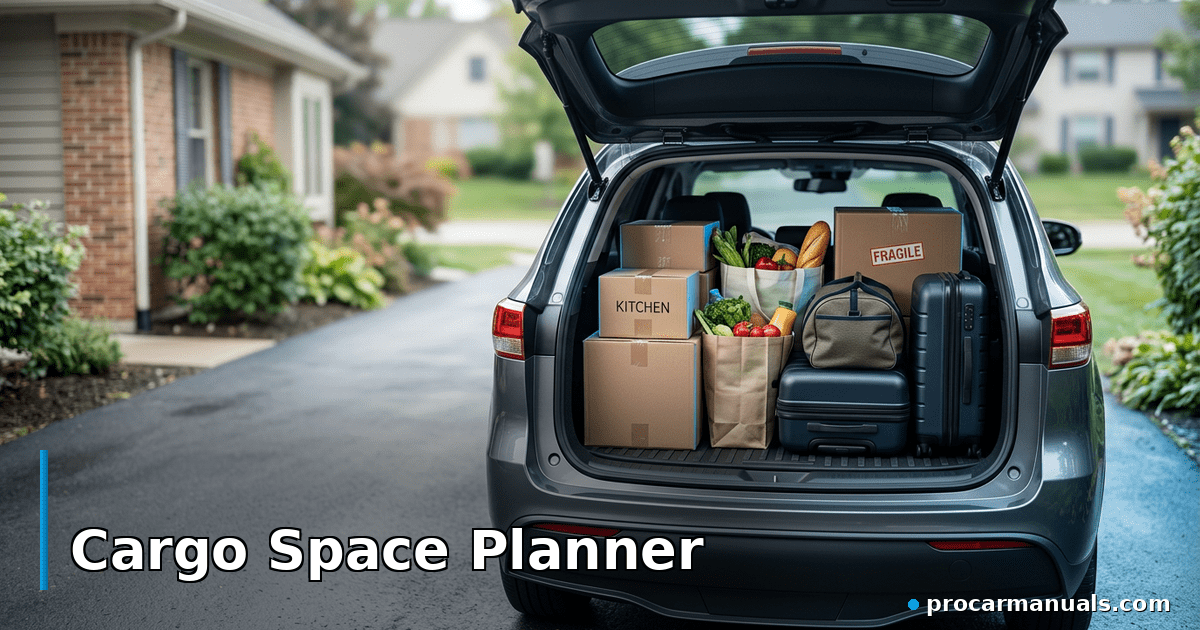
Cargo Space Planner
Find the right cargo capacity for your needs. Enter what you typically haul — groceries, sports equipment, lumber, kids’ gear — and see which SUV, wagon or pickup cargo volumes actually fit.
Cargo Volume Comparator
Compare cargo volume between two vehicles and see which fits your real-world needs.
| Vehicle | Rear | Max | Verdict |
|---|
How It Works
Cargo capacity is measured behind the second row (most useful) and behind the front row (max). The calculator maps your typical loads to volume requirements and ranks candidate vehicles.
How to Use This Calculator
- Tick the cargo categories you carry regularly (groceries, sports, lumber, etc.).
- Add weekly trip frequency.
- Pick the seating configuration you need.
- Calculator returns required cargo volume and matching vehicle classes.
Worked Example
Reference Table
Cargo volumes are SAE measurements — real-world usable space is usually 80–90% due to wheel wells and shapes.
| Vehicle class | Typical cargo (behind 2nd row) |
|---|---|
| Compact sedan trunk | 13–16 cu ft |
| Mid-size sedan trunk | 15–17 cu ft |
| Compact SUV | 25–30 cu ft |
| Mid-size SUV | 36–48 cu ft |
| Mid-size 3-row SUV | 13–18 cu ft behind 3rd row, 40–55 behind 2nd |
| Large SUV (Suburban) | 41 cu ft behind 3rd, 93 behind 2nd, 144 total |
| Mid-size pickup bed | 40–55 cu ft (open bed) |
Frequently Asked Questions
Why do third-row SUVs have so little cargo?
Because the cargo measurement is taken with all seats up. Behind the 2nd row (3rd folded) capacity triples — that’s the more useful number for non-passenger trips.
Are pickup beds counted in cargo cu ft?
Sometimes — but pickup beds are open to weather and not all cargo fits flat-pack. We list bed volume separately from enclosed cargo.