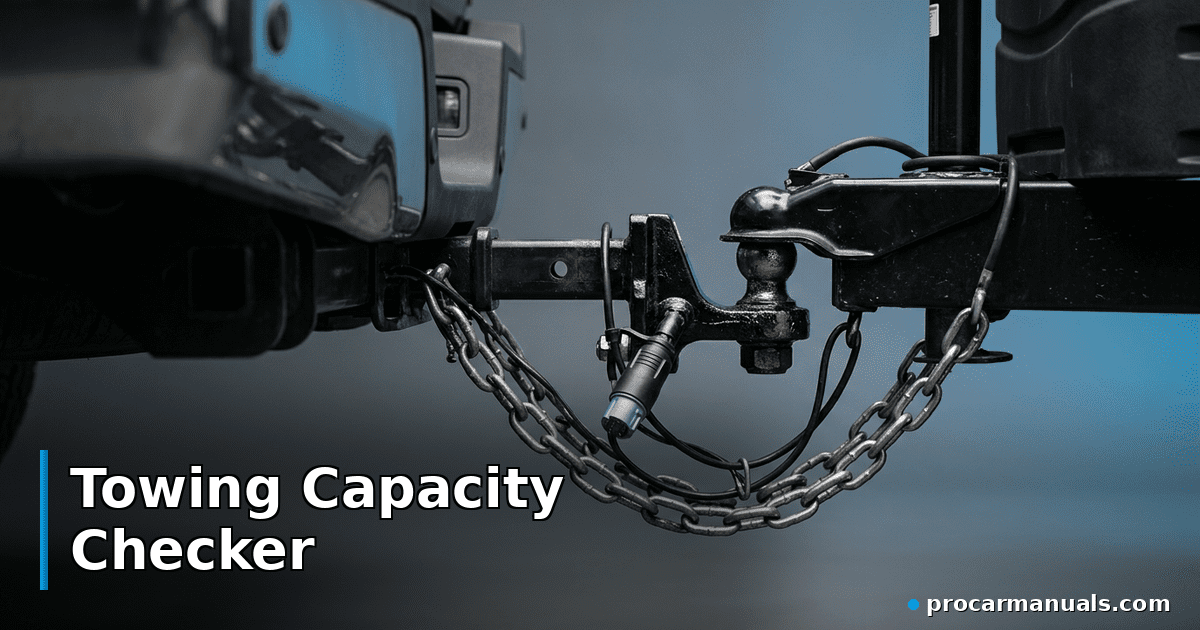
Towing Capacity Checker
Match a tow vehicle to a trailer. Calculator covers Gross Combined Weight Rating (GCWR), tongue weight, hitch class, and trailer brakes by ratings for 30+ trucks and SUVs.
Towing Capacity Lookup
Estimated towing capacity by vehicle class, engine and tow package.
How It Works
Three weights matter: trailer Gross Vehicle Weight Rating (GVWR), tongue weight (10–15% of trailer weight for conventional, 15–25% for 5th wheel), and combined GCWR. Exceeding any one is illegal and dangerous.
How to Use This Calculator
- Pick your tow vehicle — make, model, year, engine, drivetrain.
- Enter trailer loaded weight and approximate tongue weight.
- Calculator returns max safe trailer for that vehicle plus hitch class needed.
Worked Example
Reference Table
Always derate the manufacturer's max tow rating by 20% for safety margin (passengers, cargo, hills).
| Hitch class | Max GTW / Tongue |
|---|---|
| Class I | 2 000 / 200 lb |
| Class II | 3 500 / 350 lb |
| Class III | 5 000 / 500 lb (8 000 with weight distribution) |
| Class IV | 10 000 / 1 000 lb (14 000 with WD) |
| Class V | 20 000 / 2 700 lb |
| 5th wheel | 25 000+ / 5 000+ lb |
Frequently Asked Questions
Why derate to 80% of max?
Manufacturer ratings assume an empty truck and ideal conditions. Real towing includes passengers, cargo, hills, headwinds and aging brakes. 80% gives a margin for all of that.
Do I need a weight-distributing hitch?
Required by most manufacturers above 5 000 lb. It transfers tongue weight back to the trailer axles and forward to the truck's front axle, restoring steering and braking.
When do trailer brakes become required?
Federal law mandates trailer brakes above 3 000 lb GVWR in most states, and a brake controller in the tow vehicle.