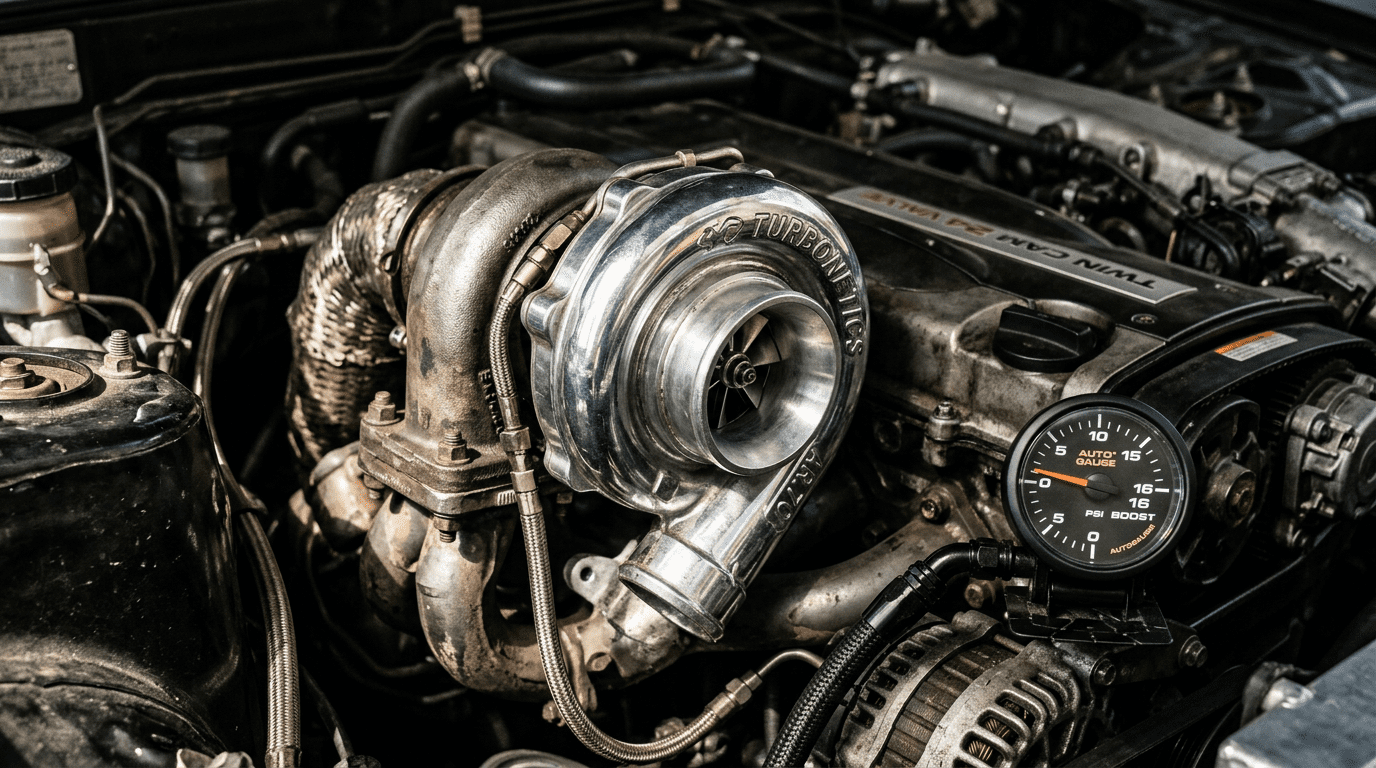
Turbo Boost Power Calculator
Estimate horsepower gain from boost pressure relative to atmospheric — quick turbo planning and intercooler sizing guide.
Boost Power Estimator
NA HP + PSI boost → estimated HP
How It Works
Boosted HP scales linearly with absolute pressure ratio. The formula HP_boost = HP_NA × ((boost + 14.7) / 14.7) assumes 100% volumetric efficiency gain from the boost. Real-world gains are typically 85–95% of this due to heat and mechanical losses.
How to Use This Calculator
- Enter the engine's naturally-aspirated HP (stock or current tuned figure).
- Enter boost pressure in PSI gauge (read from a boost gauge or ECU).
- Click Calculate — estimated boosted HP and gain appear.
- The estimate assumes ideal conditions — real-world results depend on intercooling, tune, and engine build.
- Use a conservative NA HP figure (wheel HP if available) for more realistic estimates.
Worked Example
Reference Table
| Boost PSI | Pressure Ratio | HP Multiplier | Example (200 HP NA) |
|---|---|---|---|
| 5 | 1.340 | ×1.34 | 268 HP |
| 8 | 1.544 | ×1.54 | 309 HP |
| 10 | 1.680 | ×1.68 | 336 HP |
| 14 | 1.952 | ×1.95 | 390 HP |
| 20 | 2.360 | ×2.36 | 472 HP |
| 30 | 3.041 | ×3.04 | 608 HP |
Frequently Asked Questions
Is this formula accurate for all engines?
It is an idealized estimate. Real-world gains depend on intercooler efficiency (charge cooling), wastegate calibration, injector sizing, fuel system capacity, and the engine's ability to withstand increased cylinder pressure. Built engines with forged internals realize more of the theoretical gain.
What limits the maximum safe boost level?
Stock engines have limits determined by piston strength, connecting rod strength, head gasket clamping force, and the fuel system's ability to supply enough fuel. Most stock 4-cylinder engines handle 6–12 PSI reliably; above 15 PSI usually requires internal engine upgrades.
Do I need to upgrade injectors and fuel pump with a turbo?
Yes — more air requires proportionally more fuel. At 10 PSI boost, you need roughly 68% more fuel than at NA. Undersized injectors run lean, which is the fastest path to engine failure under boost.
Why is intercooling important at higher boost levels?
Compressing air raises its temperature. Hot air is less dense (less oxygen per volume), reducing the power gain from boost. An intercooler drops charge temperature 30–80°C, recovering density and allowing more aggressive timing without knock.