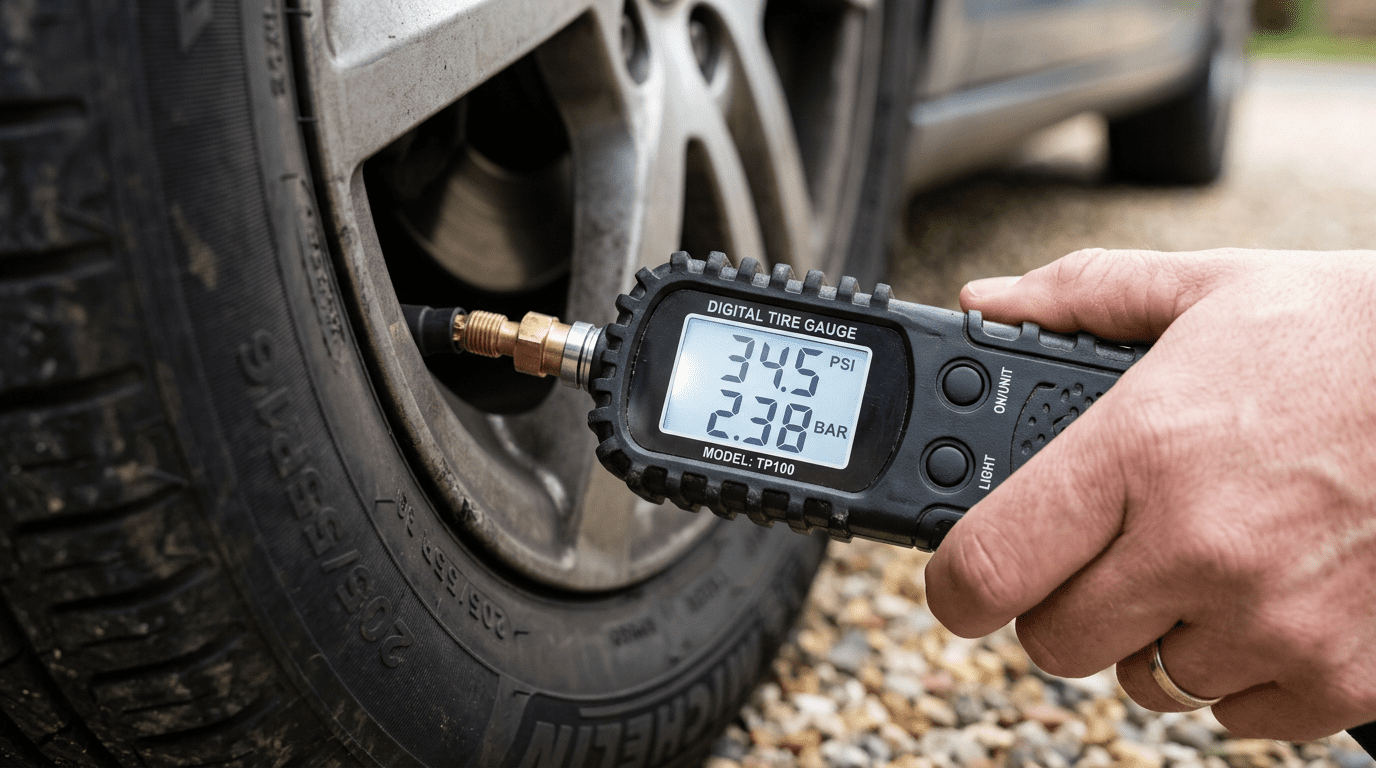
Tire Pressure Converter
Convert tire pressure between PSI, Bar, and kPa instantly — match any tyre gauge to your door-placard spec.
Tire Pressure Converter
PSI ⇄ Bar ⇄ kPa
How It Works
Tire pressure units all measure the same physical quantity (gauge pressure above atmospheric). 1 bar = 14.5038 PSI = 100 kPa. The conversion is linear.
How to Use This Calculator
- Find your door-placard or owner's manual tire pressure spec.
- Enter it in whichever unit is stated.
- Click Convert to see all three equivalents.
- Use the PSI or bar value depending on your gauge type.
- Note: check pressure when tyres are cold (less than 3 km driven).
Worked Example
Reference Table
| PSI | Bar | kPa | Typical Use |
|---|---|---|---|
| 26 | 1.79 | 179 | Undersized/under-inflated |
| 28 | 1.93 | 193 | Small car minimum |
| 30 | 2.07 | 207 | Compact car typical front |
| 32 | 2.21 | 221 | Common passenger car spec |
| 35 | 2.41 | 241 | Performance/sport setting |
| 38 | 2.62 | 262 | Some SUVs and vans |
| 80 | 5.52 | 552 | Truck steer axle (for reference) |
Frequently Asked Questions
Should I check tire pressure when the tires are hot or cold?
Always check cold — before driving or after less than 3 km. Hot tyres (after highway driving) can read 4–8 PSI / 0.3–0.6 bar higher due to air expansion. Never bleed air from hot tyres to reach the cold spec.
What is the difference between gauge pressure and absolute pressure?
Tyre pressure specs are gauge pressure — relative to atmospheric pressure (101.325 kPa). Absolute pressure = gauge + 101.325 kPa. All tyre gauges read gauge pressure, not absolute.
Does altitude affect tire pressure readings?
Gauge pressure readings change slightly at altitude because atmospheric pressure decreases. At 2 000 m altitude (atmospheric ~79 kPa), a tyre that reads 30 PSI gauge has slightly more absolute pressure than at sea level. For practical purposes, always match the placard spec with a gauge.
How much does temperature affect tyre pressure?
Approximately 1 PSI (0.07 bar) per 10°C change. A tyre inflated to 32 PSI at 20°C will drop to about 29 PSI at −10°C. Check and top up pressures each winter as temperatures drop.