Tire Life Calculator
Estimate how many kilometres are left on your tyres from current tread depth — plan your next purchase before the legal limit.
Tyre Tread Life Estimator
Current depth + wear rate → km remaining
How It Works
Tyre tread wears at a roughly linear rate under consistent conditions. The wear rate is derived from how much tread has worn over the km driven, then extrapolated to the legal minimum depth.
How to Use This Calculator
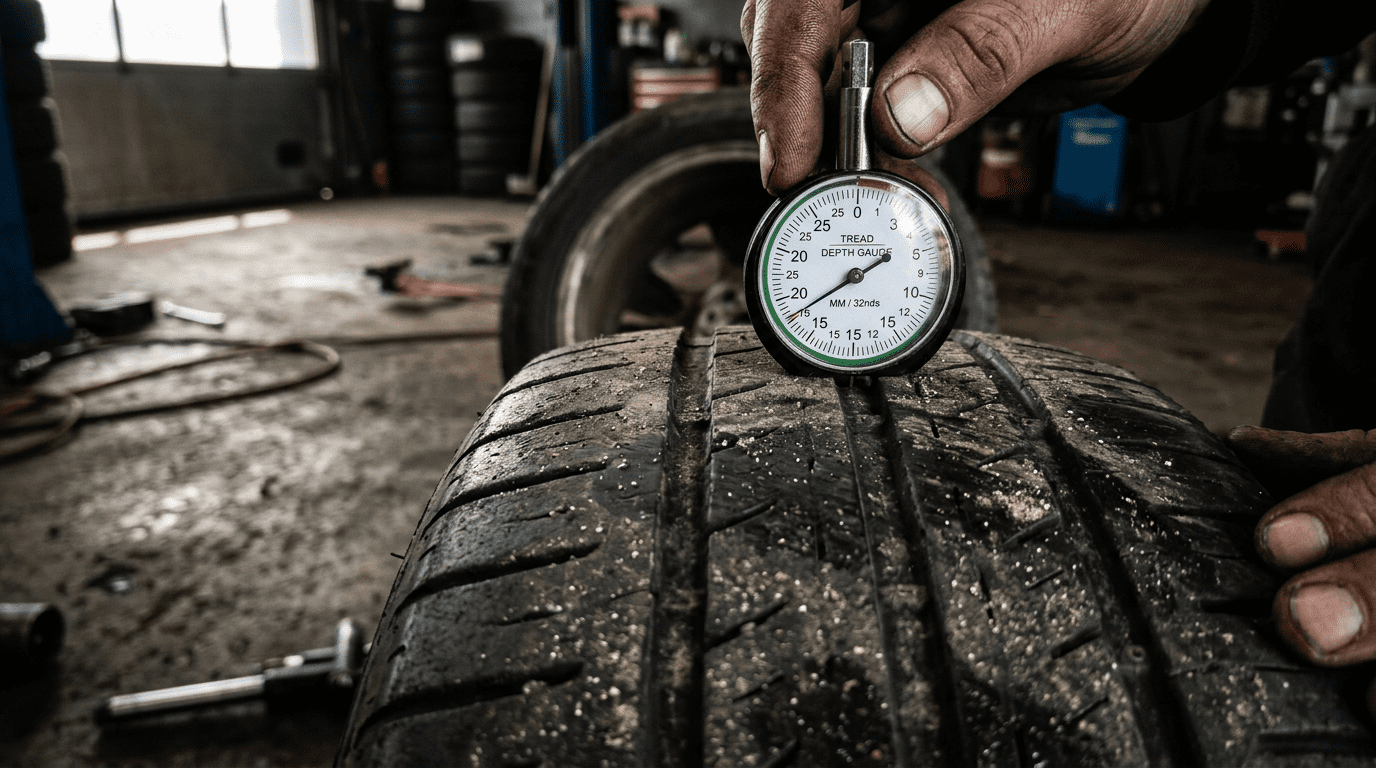
- Measure current tread depth with a depth gauge (or use a coin as a rough check).
- Enter the legal minimum depth for your region (1.6 mm in most countries).
- Enter the km driven since the tyre was new.
- Enter the new tyre depth (check your tyre brand's spec — usually 7–9 mm for passenger tyres).
- Click Calculate — remaining km estimate appears.
Worked Example
Reference Table
| Tread Depth (mm) | 2/32 in | Condition | Recommendation |
|---|---|---|---|
| 8.0 | 10/32" | New | Normal use |
| 6.0 | 8/32" | Good | Normal use |
| 4.0 | 5/32" | Half worn | Monitor |
| 3.0 | 4/32" | Reduced wet grip | Plan replacement |
| 2.0 | 3/32" | Poor wet grip | Replace soon |
| 1.6 | 2/32" | Legal minimum | Replace immediately |
| < 1.6 | < 2/32" | Illegal | Do not drive |
Frequently Asked Questions
What is the minimum legal tyre tread depth?
Most countries require 1.6 mm (2/32") minimum remaining tread. Some states and countries recommend replacing at 3.0 mm (4/32") for adequate wet-weather safety, as tread below 3 mm significantly increases hydroplaning risk.
How accurate is the linear wear model?
Reasonably accurate for consistent driving habits. Aggressive driving, hard cornering, and frequent sharp braking accelerate outer-tread wear non-linearly. High-performance tyres typically wear faster than touring tyres under the same conditions.
Do front and rear tyres wear at different rates?
Yes — front-wheel-drive cars wear front tyres 2–3× faster than rear tyres due to combined steering and driving forces. RWD cars wear rears faster. Rotating tyres every 10 000 km equalizes wear and extends the set's total life.
What tread depth is actually safe for wet roads?
Stopping distance on wet roads increases significantly below 3 mm tread. At 1.6 mm tread, wet stopping distance at 80 km/h can be 30–50% longer than a new tyre. Replacing at 3 mm is the safety-conscious choice.