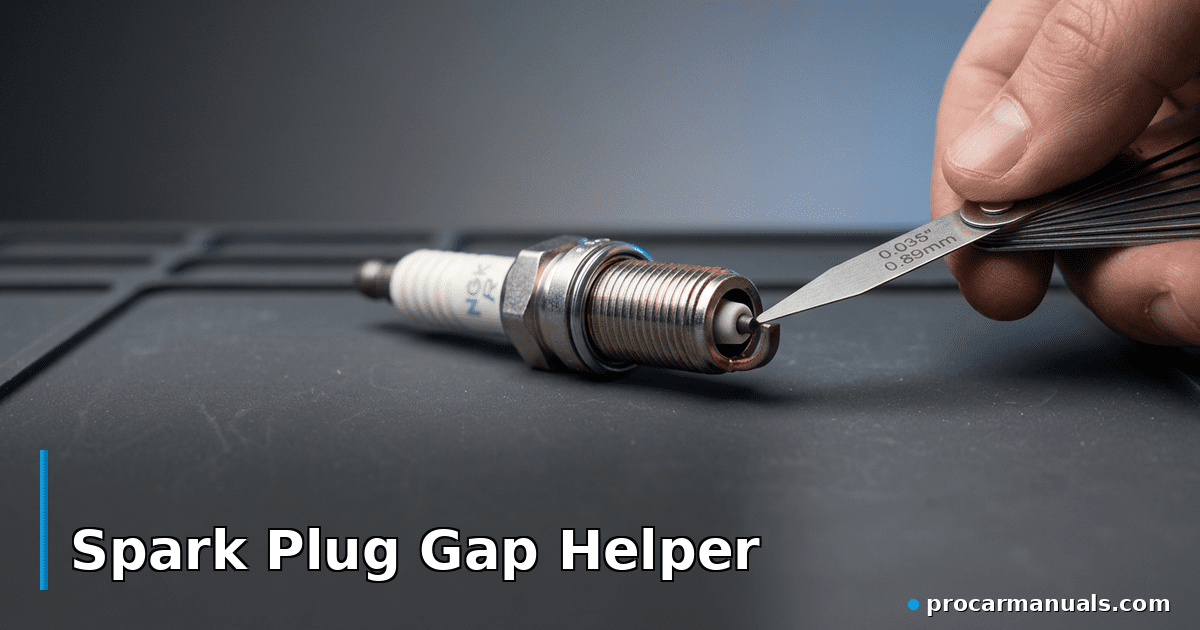
Spark Plug Gap Helper
Convert spark plug gap between inches, millimeters, and thousandths of an inch, and verify it matches your engine’s factory spec. Wrong gap causes misfires, hard starting, reduced fuel economy, and ignition coil failure.
Spark Plug Gap & Replacement
Pick the right gap, replacement interval, and torque for your plug type.
How It Works
Spark plug gap controls the size of the arc that ignites the fuel-air mixture. Too small = weak ignition, fouling, misfires under load. Too large = coil works too hard, premature coil failure. Manufacturer spec is engineered for the specific ignition system voltage and combustion chamber design.
How to Use This Calculator
- Find your engine’s spec on the under-hood emission decal or owner’s manual.
- Measure each plug with a wire-style gap tool (more accurate than disc-style).
- Compare to spec — typical tolerance is ±0.002″ (±0.05 mm).
- Bend the side electrode gently to adjust — never pry against the center electrode.
- Re-measure after every adjustment.
Worked Example
Reference Table
Typical gaps by engine type. Always defer to the under-hood emissions label or service manual — these are general ranges only.
| Engine type | Typical gap (inches) | Typical gap (mm) |
|---|---|---|
| Naturally aspirated 4-cyl | 0.040–0.044″ | 1.02–1.12 mm |
| Naturally aspirated V6/V8 | 0.043–0.050″ | 1.09–1.27 mm |
| Turbocharged 4-cyl | 0.026–0.032″ | 0.66–0.81 mm |
| Turbocharged V6/V8 | 0.028–0.034″ | 0.71–0.86 mm |
| Supercharged | 0.024–0.030″ | 0.61–0.76 mm |
| LPG / CNG converted | 0.022–0.028″ | 0.56–0.71 mm |
| Diesel pre-glow plug | N/A | N/A |
Frequently Asked Questions
Are iridium and platinum plugs pre-gapped?
Yes, but factory pre-gap is set for a “generic” engine. Always verify against your specific engine spec before installing. Iridium plugs need careful gap adjustment — the fine electrode is fragile.
How often should I change spark plugs?
Copper plugs: 30 000 miles. Platinum: 60 000–80 000 miles. Iridium / iridium-platinum: 100 000–120 000 miles. Some modern long-life plugs claim 150 000 miles but real-world wear catches up around 100 000.
Why are my new plugs already misfiring?
Most common: incorrect gap. Second: damaged porcelain from over-tightening. Third: cross-threaded — even if it threaded in, the seal is bad. Always torque to spec (typically 13–25 lb-ft).
Can I gap plugs without a gap tool?
No. Eyeballing or using a feeler-style gauge on an iridium plug damages the fine electrode. A wire-style tool costs $5 — use it.
Why does my engine spec a wider gap than my friend’s same-displacement engine?
Ignition system voltage and combustion chamber geometry differ. Newer coil-on-plug systems with higher voltage tolerate wider gaps; older distributor systems specify tighter gaps because the coil can’t bridge as much.