Spark Plug Gap Guide
Look up the correct spark plug gap range for your engine type and convert any gap measurement between inches and millimeters instantly.
Spark Plug Gap Guide
Engine Type Lookup + Inch ↔ mm Converter
How It Works
The guide uses an internal lookup table keyed to engine type to return the manufacturer-recommended gap range. The converter uses the exact factor 1 inch = 25.4 mm to convert in either direction.
How to Use This Calculator
- Select your engine type from the dropdown to see the recommended gap range.
- Optionally enter a gap in inches or millimeters to convert to the other unit.
- Click Look Up to display the recommended range, conversion, and notes.
- Cross-reference the result with the sticker under your hood or your OEM service manual.
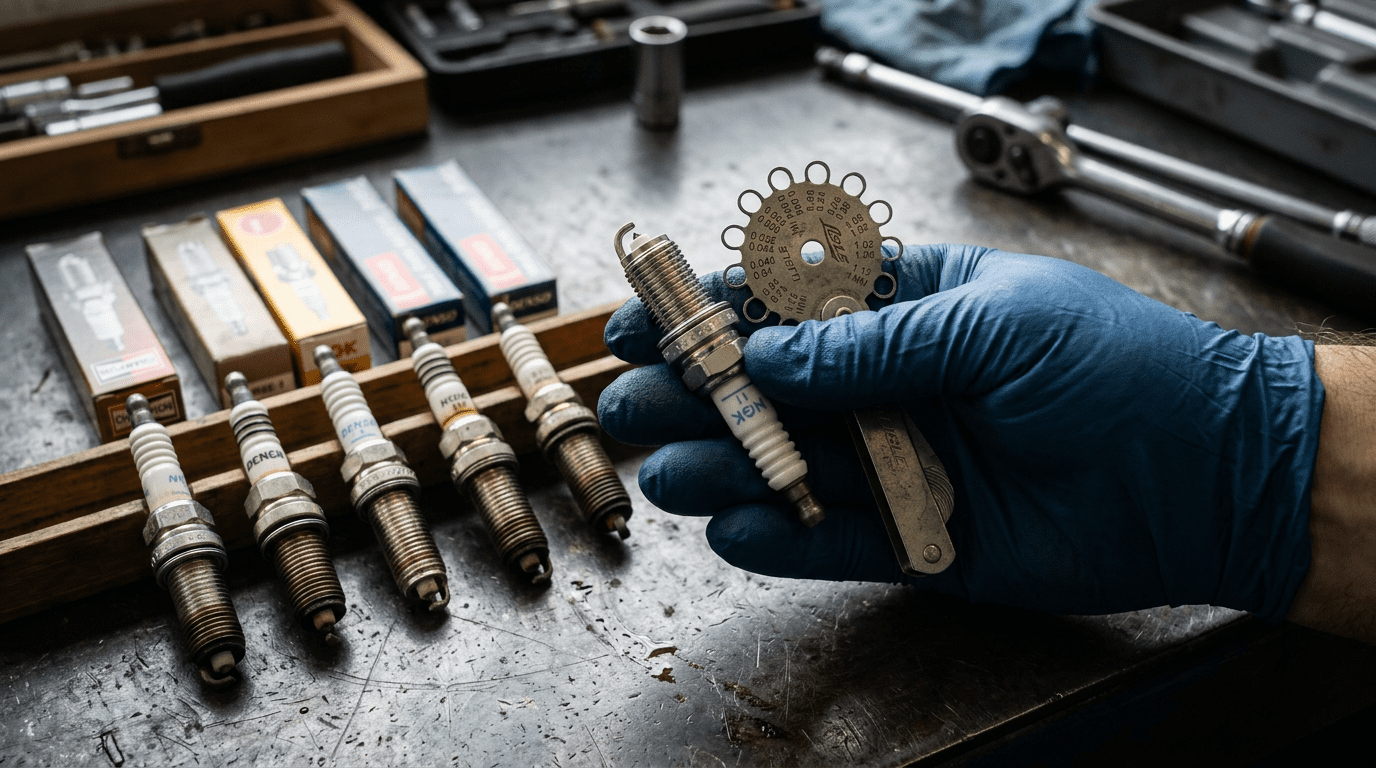
- Use a feeler gauge or coin-style gap tool to set the plug gap before installation.
Worked Example
Reference Table
| Engine Type | Gap (mm) | Gap (in) | Typical Ignition | Examples |
|---|---|---|---|---|
| NA modern (COP) | 0.7–0.9 | 0.028–0.035 | Coil-on-plug | Toyota 2GR, Honda K20, GM Ecotec |
| Turbocharged | 0.6–0.7 | 0.024–0.028 | Coil-on-plug | Ford EcoBoost, Subaru FA20T, BMW N20 |
| High-performance | 0.5–0.6 | 0.020–0.024 | Multi-coil / CDI | LS engines, Evo 4B11T, rally prep |
| Older / HEI (80s) | 1.0–1.5 | 0.040–0.060 | HEI distributor | GM TBI V8, Ford 5.0 HO, Mopar 318 |
| Older points ignition | 0.6–0.9 | 0.025–0.035 | Points distributor | 1960s–70s carb engines |
| Diesel (glow plug) | N/A | N/A | Compression ignition | No spark plug gap required |
Frequently Asked Questions
What happens if the spark plug gap is too wide?
A gap that is too wide requires more voltage to jump the gap. Under boost or at high RPM the ignition system may not produce enough voltage, causing misfires, rough idle, and a check-engine P030x code. Turbocharged engines are especially sensitive because boost pressure further impedes spark.
What happens if the spark plug gap is too narrow?
A gap that is too narrow produces a weaker spark with a shorter arc duration. This can cause incomplete combustion, reduced power output, and increased fuel consumption. A very tight gap may also foul quickly with carbon deposits.
Should I adjust the gap on iridium or platinum plugs?
Most iridium and platinum plugs are pre-gapped from the factory and manufacturers strongly advise against adjusting them, as bending the fine electrode can chip the precious-metal tip. Always verify the gap with a wire feeler gauge (not a coin-type tool) without applying bending force.
How often should spark plugs be replaced?
Copper plugs: 30,000–45,000 km. Platinum single/double: 60,000–100,000 km. Iridium long-life plugs: 100,000–160,000 km or per OEM interval. Always check the current gap at replacement — worn electrodes increase gap over time.