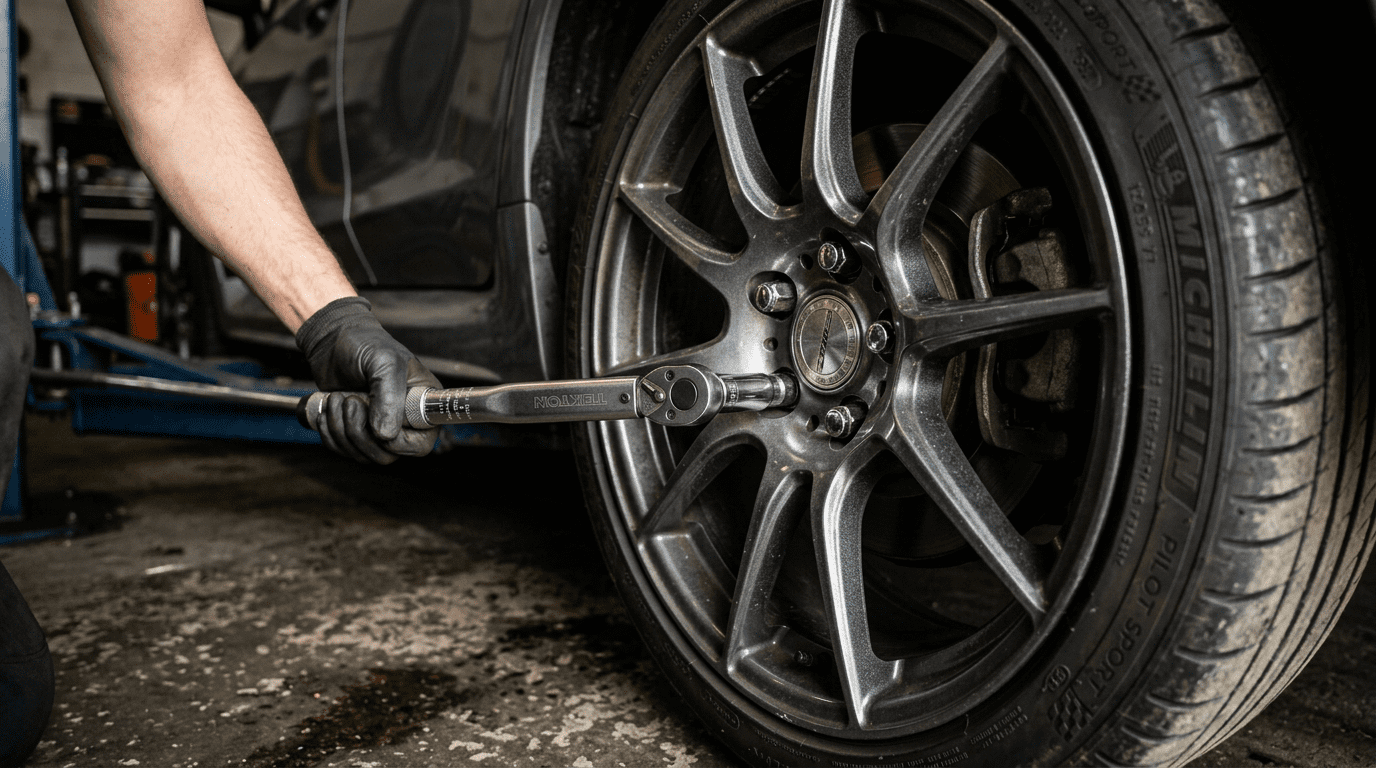
Lug Nut Torque Guide
Get the correct lug nut tightening sequence and torque range for your wheel’s bolt count — essential for safe wheel installation.
Lug Nut Torque & Sequence
Bolt count → torque spec + star pattern
How It Works
The cross/star tightening pattern ensures the wheel seats evenly against the hub without warping the brake rotor. Torque ranges vary by vehicle — always use the manufacturer’s spec from the workshop manual when available.
How to Use This Calculator
- Count the bolts/studs on your wheel hub.
- Select the correct bolt count from the dropdown.
- Click Show Guide — torque range and sequence diagram appear.
- Hand-tighten all nuts first, then use a torque wrench following the sequence.
- Torque to spec in two passes: 50% torque first pass, 100% second pass.
Worked Example
Reference Table
| Vehicle Type | Bolt Pattern | Typical Torque | Thread Size |
|---|---|---|---|
| Compact car | 4-bolt | 80–100 Nm | M12 × 1.5 |
| Mid-size sedan | 5-bolt | 100–120 Nm | M12 × 1.5 |
| Sport/performance | 5-bolt | 120–140 Nm | M14 × 1.5 |
| Light truck/SUV | 5 or 6-bolt | 130–160 Nm | M14 × 1.5 |
| Heavy truck | 8-bolt | 200–250 Nm | M22 × 1.5 |
Frequently Asked Questions
Why must I follow a star pattern when tightening wheel bolts?
Tightening in a circular pattern can tilt the wheel on the hub face, causing uneven clamping. This leads to brake rotor runout (wobble), pulsating brakes, and in severe cases, the wheel working loose. The star pattern applies force evenly across the hub.
Can I use an impact wrench to tighten wheel nuts?
Impact wrenches can overtighten or undertighten and should not be used as a final tightening tool. Use them to run nuts down quickly, then finish with a calibrated torque wrench. Over-torquing can warp rotors and stretch or break studs.
Should I re-torque wheel nuts after driving?
For safety-critical work (first installation after brake work), re-checking torque after 50–100 km is recommended. Wheel nuts can settle slightly after the first drive. For routine tyre rotations, re-checking is good practice but less critical.
Are all lug nuts the same size and thread pitch?
No — most passenger cars use M12 × 1.5 or M14 × 1.5 metric thread. Always use nuts matching your stud thread. Incorrectly matched threads will cross-thread and can lead to stud failure. Check the thread pitch of replacement nuts before installation.