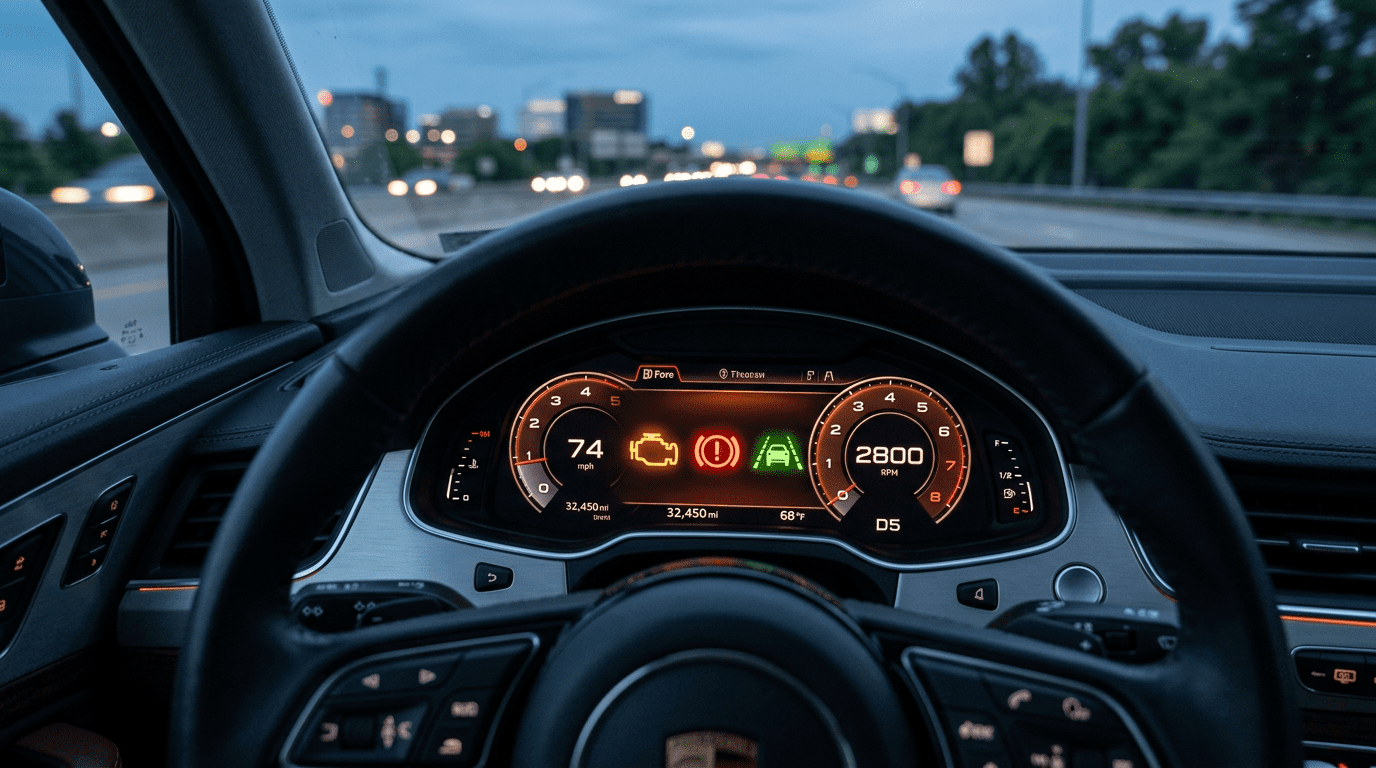
Dashboard Light Colors Guide
Learn what red, amber, yellow, green, and blue dashboard lights mean and exactly how urgently you should act on each.
Dashboard Light Color Guide
Select color → urgency + action
How It Works
Dashboard warning lights follow an international color code system (ISO 4040 standard) used by almost all vehicle manufacturers. Color alone tells you the urgency level before you identify the specific light.
How to Use This Calculator
- Identify the color of the unfamiliar dashboard light.
- Select the color from the dropdown.
- Click Look Up — urgency level and recommended action appear.
- Use the Warning Lights Guide for specific light identification.
- When in doubt, treat any red light as an immediate stop situation.
Worked Example
Reference Table
| Color | Urgency | Action Time | System Examples |
|---|---|---|---|
| Red | Critical | Stop now | Oil, temp, brakes, airbag, steering |
| Amber/Orange | Important | Hours–days | CEL, ABS, ESP, TPMS, transmission |
| Yellow | Advisory | Days–weeks | Service reminder, fuel, fluids |
| Green | Active | None | Turn signal, cruise, lane assist |
| Blue | Information | None | High beam on, EV connected |
| White | Status | None | Autopilot, system confirmation |
Frequently Asked Questions
Is the color system the same in all countries?
ISO 4040 and ECE regulations standardize warning light colors across most countries. Red is universally reserved for critical/stop situations. Amber covers service needs. Green and blue are informational. Some older vehicles (pre-2000) may not follow the modern color standard as strictly.
Can I ignore an amber light for a few days?
For most amber lights (e.g., service reminder, low fuel), a few days is acceptable. However, for ABS, ESP, TPMS, or CEL (flashing), prompt attention is important. ABS failure leaves you without anti-lock braking in an emergency stop.
Why do some vehicles have different shades of amber vs orange vs yellow?
There is slight variation in implementation. In practice, treat any warm-colored light in the amber-orange-yellow range as a service warning. The key distinction is red (stop) vs not-red (service/info).
What should I do if I can’t identify a specific light?
Pull over safely if the light is red. For amber: look up the symbol in the owner’s manual (indexed in the back), or search your vehicle make/model + the symbol description online. Our Warning Lights Guide covers the most common 25 symbols.