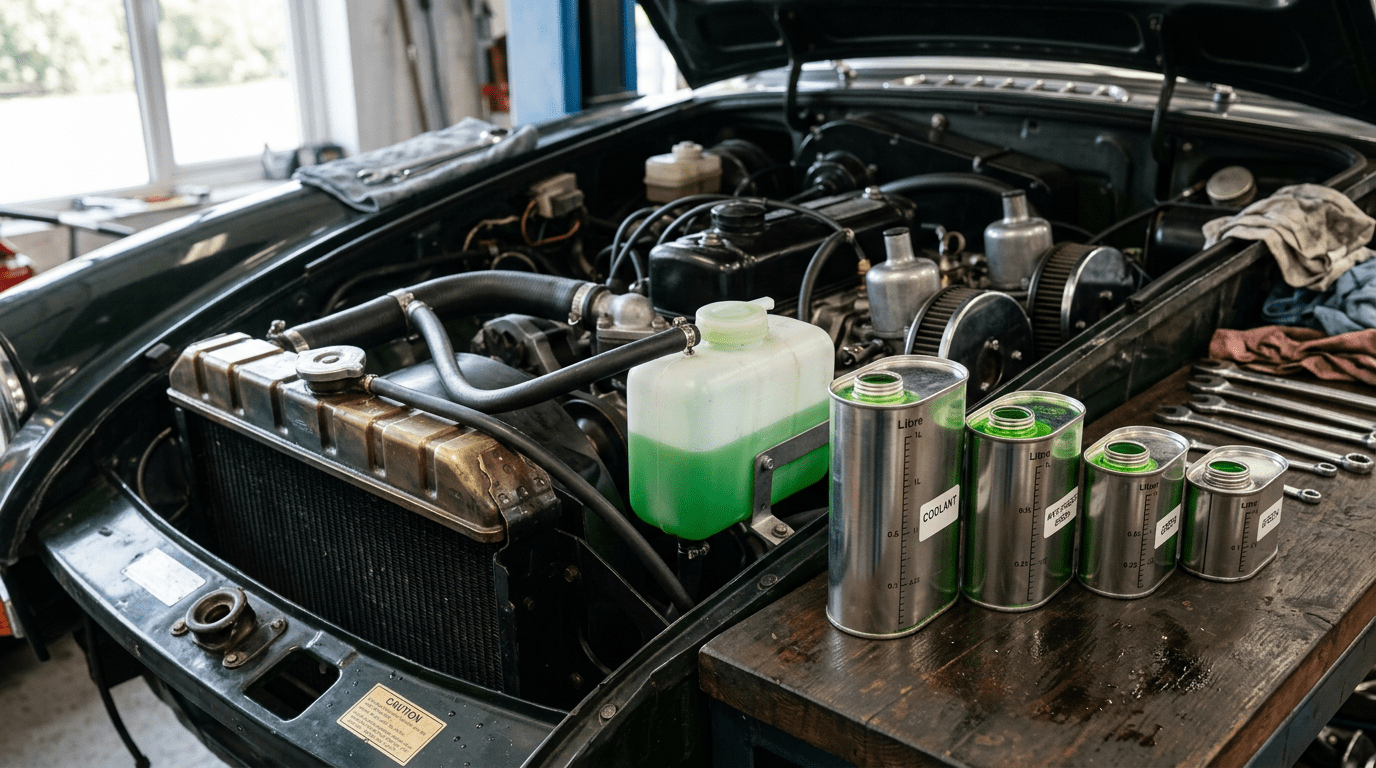
Coolant System Capacity Guide
Look up typical cooling system capacity ranges by engine displacement or configuration, in both liters and US quarts.
Coolant Capacity Guide
Engine Displacement → Typical Coolant Volume
How It Works
This guide maps engine displacement ranges to typical cooling-system total fill volumes based on aggregated OEM service data. The values cover the entire system: engine block passages, cylinder head, radiator, heater core, and overflow reservoir. Actual values vary by model — always cross-reference your service manual before purchasing coolant.
How to Use This Calculator
- Select the displacement range or engine configuration that matches your vehicle.
- Click Look Up to see the typical total coolant volume in liters, US quarts, and gallons.
- Use the range as a shopping guide to buy enough coolant concentrate and distilled water.
- After a full flush, add coolant gradually and burp the system to eliminate air pockets.
- Always verify the exact spec in your vehicle’s OEM service manual before performing a flush.
Worked Example
Reference Table
| Engine Range | Capacity (L) | Capacity (qt) | Example Vehicles |
|---|---|---|---|
| Under 1.0 L | 4.0–5.0 | 4.2–5.3 | Suzuki Alto, Kei cars, Smart ForTwo |
| 1.0–1.6 L | 4.5–6.0 | 4.7–6.3 | Honda Civic 1.5T, Toyota Yaris, VW Polo |
| 1.6–2.0 L | 6.0–8.0 | 6.3–8.5 | Toyota Corolla, VW Golf, Mazda 3 |
| 2.0–2.5 L | 7.5–9.5 | 7.9–10.0 | Honda Accord, Subaru Outback, Ford Focus ST |
| 2.5–3.0 L (6-cyl) | 8.5–10.5 | 9.0–11.1 | Toyota Camry V6, Nissan Altima 3.5 |
| 3.0–4.0 L V6 | 10.0–12.5 | 10.6–13.2 | Ford F-150 3.5T, Dodge Charger V6, BMW 330 |
| 4.6–5.0 L V8 | 13.5–16.0 | 14.3–16.9 | Ford Mustang GT, GM LS3, Toyota Tundra 5.7 |
| 5.4–6.2 L V8 | 15.0–18.0 | 15.9–19.0 | Ford F-250 6.2, Dodge Hellcat 6.2, GM LS7 |
| 6.6–7.3 L Diesel V8 | 20.0–28.0 | 21.1–29.6 | Ford 7.3 Power Stroke, GM Duramax 6.6 |
| Heavy-Duty Diesel | 24.0–32.0 | 25.4–33.8 | RAM 6.7 Cummins, International DT466 |
Frequently Asked Questions
What is the correct coolant-to-water ratio for freeze protection?
A 50/50 mix of ethylene glycol concentrate and distilled water protects to about −37°C (−34°F) and is the standard recommendation for most climates. A 60/40 concentrate-to-water ratio lowers protection to −52°C (−62°F) for arctic conditions, but concentrations above 70% actually raise the freeze point. Never use tap water — minerals cause scale deposits and corrosion.
Can I mix different colors of coolant?
Color alone does not indicate compatibility — manufacturers dye coolant to match their brand, not chemistry. Mixing OAT (Organic Acid Technology), HOAT (Hybrid OAT), and older IAT (Inorganic Additive Technology) coolants can cause silicate dropout, gel formation, and accelerated aluminum corrosion. Always flush completely before switching chemistry.
How often should the cooling system be flushed?
Most modern long-life coolants are rated 5 years or 150,000 km with OAT/HOAT chemistry. Older green IAT coolant degrades faster and should be replaced every 2 years or 50,000 km. After the specified interval, pH drops and corrosion inhibitors deplete, leading to silicate scale and radiator damage.
Why is there an air pocket after I refill the coolant?
Air pockets form when coolant is added too quickly or when bleed screws are not opened. Air in the cooling system prevents full circulation, creates hot spots, and can cause the thermostat to open incorrectly, triggering overheating. Always fill slowly with the heater set to maximum, run the engine to operating temperature, and top up as the thermostat opens and air escapes.