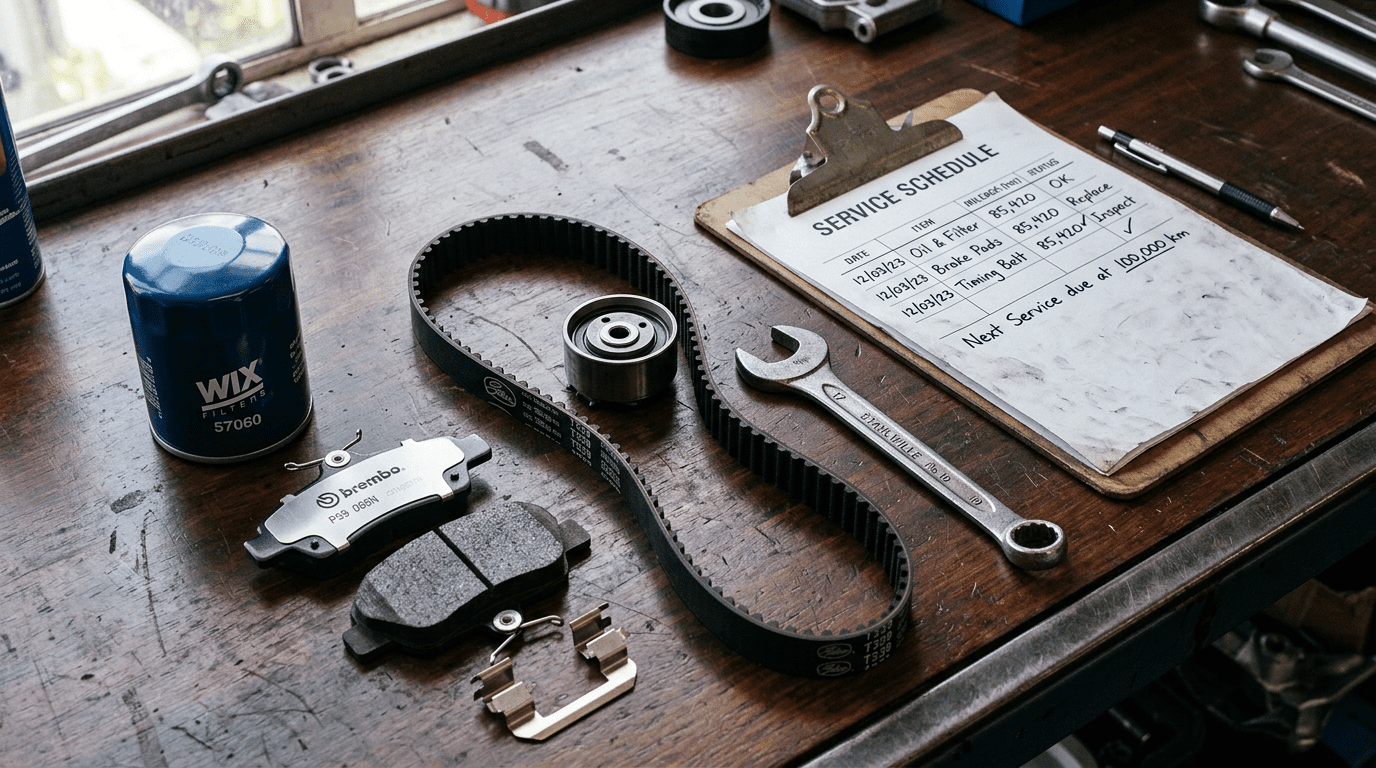
Car Maintenance Schedule
Enter your current mileage and get a complete next-due mileage schedule for all common service items.
Maintenance Schedule Generator
Current mileage → complete service schedule
How It Works
The tool uses standard intervals for common service items. It rounds down to the nearest completed interval from your mileage, then adds one interval to find the next due point. Items within 3 000 km are highlighted red.
How to Use This Calculator
- Enter your current odometer reading in km.
- Click Generate Schedule — all common service items appear.
- Red items are due within 3 000 km — schedule these soon.
- Cross-check with your owner’s manual for model-specific intervals.
- Use this as a planning guide, not a substitute for manufacturer requirements.
Worked Example
Reference Table
| Service Item | Typical Interval | Skip at Your Risk |
|---|---|---|
| Engine oil | 10–15 000 km | Sludge, bearing wear |
| Coolant | 50 000 km / 5 yr | Corrosion, pump failure |
| Brake fluid | 40 000 km / 2 yr | Wet fluid boils under hard braking |
| Timing belt | 60–100 000 km | Engine destruction if it snaps |
| Brake pads | 30–50 000 km | Rotor damage, brake failure |
| Air filter | 25 000 km | Power loss, MAF contamination |
Frequently Asked Questions
How do I know which intervals apply to my specific car?
Always use the intervals in your owner’s manual as the primary reference. Manufacturers engineer maintenance schedules around their specific components. Generic guides are useful starting points but not substitutes.
What is a ‘major service’ vs a ‘minor service’?
A minor service typically covers oil, filter, and visual checks. A major service adds plugs, air filter, cabin filter, fluid checks, and brake inspection. An ‘interim service’ is a mid-cycle oil change only.
Can I skip the coolant flush if the coolant looks clean?
No — OAT, HOAT, and NOAT coolants degrade chemically even when still coloured correctly. Silicate additives deplete over time, reducing corrosion protection regardless of appearance.
Why does brake fluid need to be changed if it still looks clear?
Brake fluid is hygroscopic — it absorbs moisture from the air over time. Water lowers the boiling point from 250°C+ (dry) to as low as 160°C (wet). Under hard braking, wet fluid can vapour-lock, causing a sudden loss of brake pressure.