Car Battery Group Size Guide
Look up BCI battery group sizes, dimensions, and typical fitment to find a compatible replacement battery for your vehicle.
Battery Group Size Reference
Select group → dimensions + fitment
How It Works
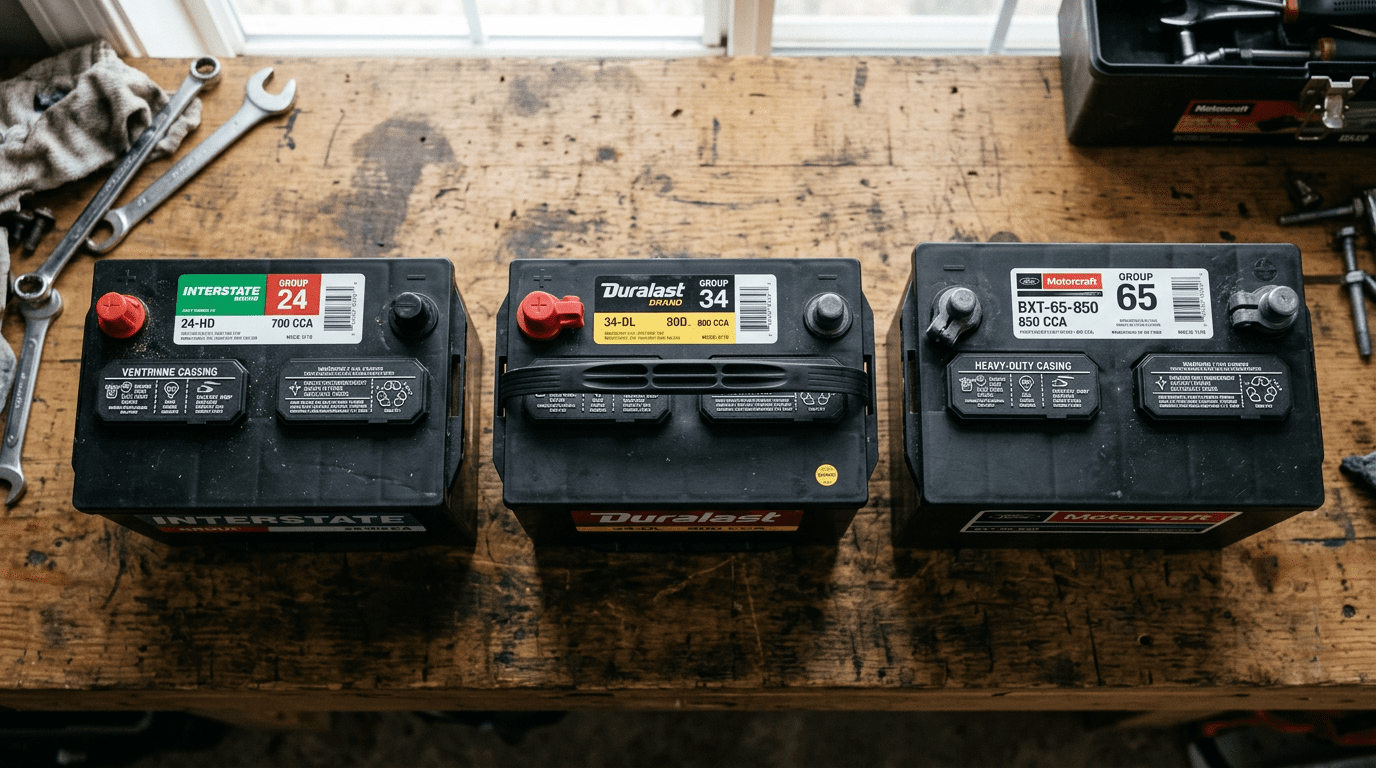
BCI (Battery Council International) group sizes standardize battery dimensions and terminal placement. Selecting the correct group ensures the battery fits the tray and the terminals reach the cables.
How to Use This Calculator
- Check the existing battery or owner’s manual for the BCI group number (printed on the battery label).
- Select the group from the dropdown.
- Click Look Up — dimensions, terminal layout, and common fitment appear.
- When buying a replacement, match the group size exactly.
- Choose a CCA (Cold Cranking Amps) rating at or above the OEM specification.
Worked Example
Reference Table
| BCI Group | L×W×H (mm) | Typical Vehicle | CCA Range |
|---|---|---|---|
| 35 | 230×175×225 | Toyota, Honda, Nissan, Subaru | 640–850 |
| 48 (H6) | 278×175×190 | BMW, Audi, VW, Mercedes | 700–900 |
| 49 (H8) | 353×175×190 | BMW, Audi, Porsche | 800–1000 |
| 65 | 306×192×192 | Ford trucks, large SUVs | 750–950 |
| 51R | 238×129×223 | Toyota, Mazda, Nissan (Japanese) | 450–550 |
| 24F | 260×173×225 | Honda, Acura | 550–800 |
Frequently Asked Questions
Can I use a higher-group battery if it physically fits?
Only if the voltage (12V), terminal polarity, and dimensions match. A higher-group battery often has higher CCA and Ah capacity, which is beneficial. However, never use a battery that causes terminal cables to stretch or apply mechanical stress to the terminals.
What does CCA mean and how much do I need?
Cold Cranking Amps (CCA) is the battery’s ability to start the engine at 0°F (-18°C). Generally, match or exceed the OEM CCA spec. In colder climates, increasing CCA by 10–20% above spec provides better cold-weather starting.
Is a AGM battery better than a standard flooded battery?
AGM (Absorbent Glass Mat) batteries are significantly better for cars with stop-start systems, heavy accessory loads, or frequent short trips. They cost 2–3× more but last longer and handle deep cycling. Standard flooded batteries are adequate for simple older vehicles.
How long should I expect a replacement battery to last?
Quality batteries (Optima, Odyssey, Bosch, Exide Premium) typically last 4–7 years. Budget batteries may fail in 2–3 years. Hot climates reduce life; cold climates reduce starting performance. AGM batteries typically last 5–8 years.