Brake Rotor Wear Estimator
Estimate when your brake rotors need replacement. Compare current rotor thickness to the manufacturer’s minimum thickness spec — usually 1–2 mm below original — and see how close you are to the discard limit.
Brake Rotor Wear Estimator
Estimate how much rotor material remains before reaching the discard specification.
How It Works
Rotors thin out from friction wear and from machining if they’ve been resurfaced. Every rotor has a stamped minimum thickness (MTW) — typically 22–24 mm for front discs, 8–10 mm for rear. Once you reach MTW, the rotor cannot dissipate heat safely and must be replaced.
How to Use This Calculator
- Find the stamped MIN TH or MTW value on the edge of the rotor.
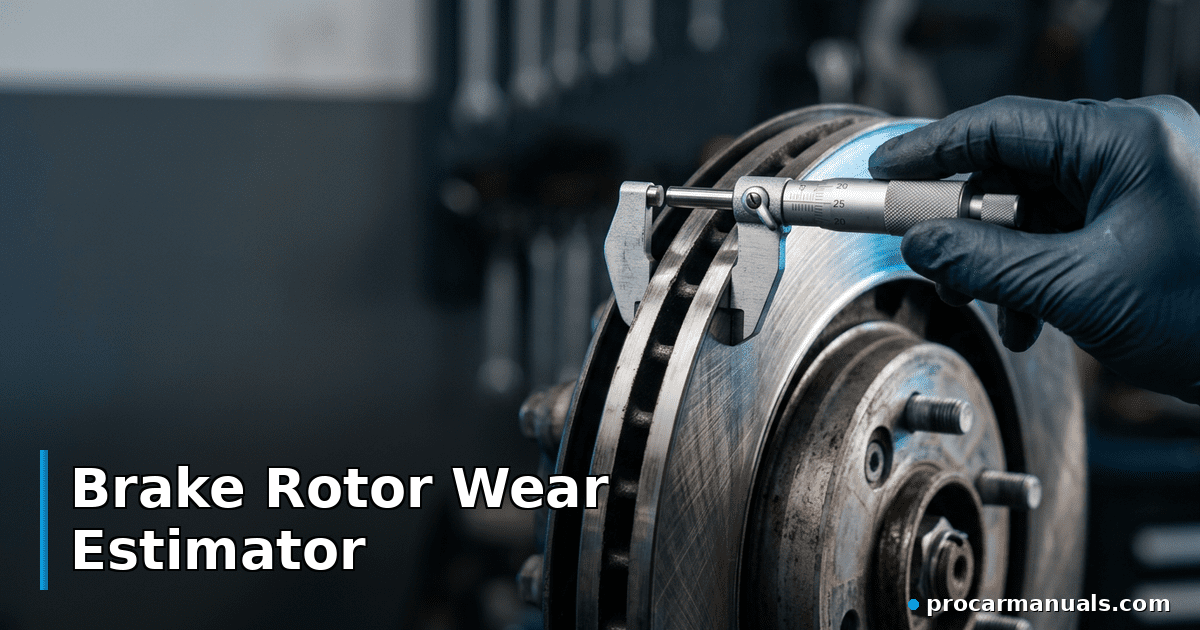
- Measure rotor thickness with a micrometer at 8 equidistant points around the disc.
- Use the thinnest of those 8 readings as your current thickness.
- Enter both values into the calculator to see remaining wear margin.
- Replace the rotor (always in pairs across one axle) once the margin drops below 0.5 mm.
Worked Example
Reference Table
Always confirm with your vehicle service manual — the stamped MIN TH value on the rotor is authoritative.
| Vehicle class | Typical new thickness | Typical minimum |
|---|---|---|
| Compact sedan front | 22–24 mm | 20–22 mm |
| Compact sedan rear | 10–12 mm | 8–10 mm |
| Midsize SUV front | 28–30 mm | 26–28 mm |
| Full-size pickup front | 30–34 mm | 28–32 mm |
| Performance / sport | 32–36 mm | 30–34 mm |
| Light truck rear drum | N/A (use shoe wear gauge) | N/A |
Frequently Asked Questions
Can rotors be resurfaced or do I need new ones?
Resurfacing is only worthwhile if rotors are above MTW + 1.5 mm. Modern rotors are thin enough that machining usually leaves them below safe limits, and most shops simply replace.
Why are my rotors warped?
Warping is rarely actual deformation — it’s usually uneven pad-material transfer caused by overheating. The fix is new pads, new rotors, and a proper break-in procedure (10 moderate stops from 30 mph).
Should I replace rotors with pads every time?
If rotors are below the minimum spec or show deep scoring, yes. Otherwise pads-only is fine if the rotor surface is smooth and within spec.
How long do brake rotors last?
Typically 50 000–80 000 miles on the fronts. Aggressive driving, towing, and downhill driving shorten this significantly.
Are coated rotors worth it?
Coated (geomet/zinc-plated) rotors resist rust on the hat and edge — important in salt-belt regions. Friction surface is identical to bare rotors.