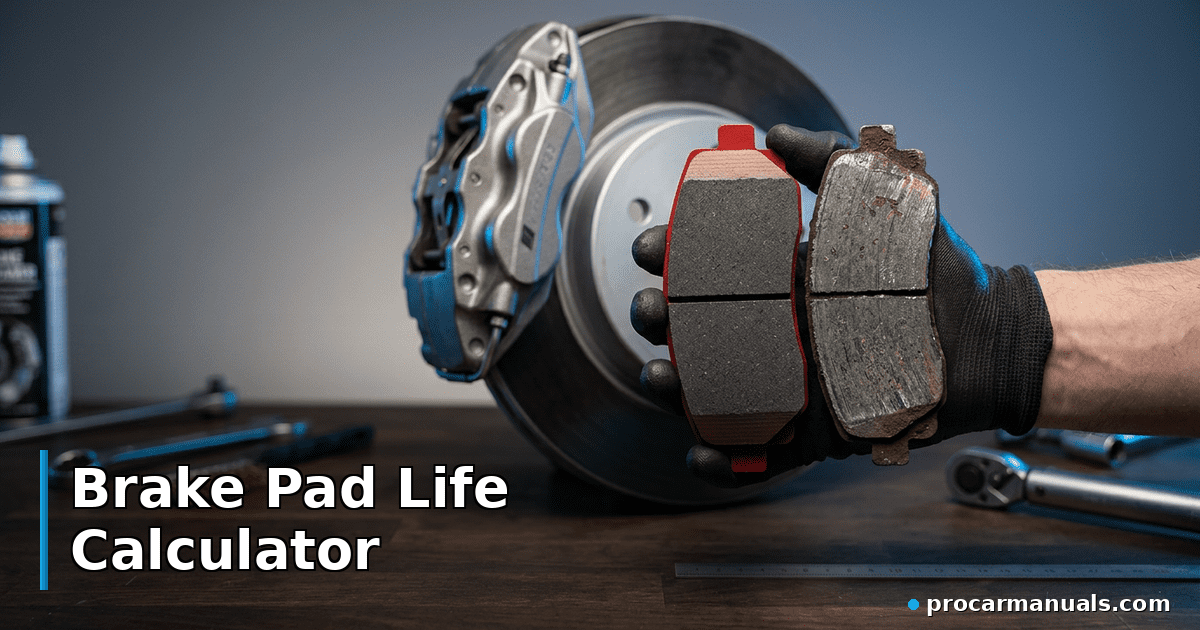
Brake Pad Life Calculator
Calculate exactly how much brake pad life you have left and how many miles you can drive before replacement. Enter your initial and current pad thickness plus miles driven — the calculator returns percent remaining, estimated miles left, and a warning if pads are at or below 3 mm.
Brake Pad Life Calculator
Estimate remaining brake pad life based on current thickness and driving habits.
How It Works
Brake pad wear is linear with mileage for highway-dominant driving and curves slightly for stop-and-go. The calculator uses your current vs initial thickness to compute percent worn, then projects remaining mileage by extrapolating the same wear rate. The 3 mm threshold matches federal safety guidance — most states consider pads below 3 mm worn beyond safe use.
How to Use This Calculator
- Measure your initial brake pad thickness — typically 10–12 mm for new OE pads.
- Measure current thickness with a caliper through the wheel spokes or after removing the wheel.
- Enter total miles driven since the pads were new.
- Click Calculate to see remaining life and estimated miles before replacement.
- If the calculator warns you about ≤3 mm, schedule replacement within the next 500 miles.
Worked Example
Reference Table
Typical pad-thickness thresholds for passenger vehicles. Heavy-duty trucks and performance cars use thicker initial pads — check your owner’s manual.
| Pad thickness | Status | Action |
|---|---|---|
| 10–12 mm | New / like-new | No action — track wear at next service |
| 7–10 mm | Healthy | Inspect at every oil change |
| 4–7 mm | Worn | Inspect every 3 000 miles, plan replacement |
| 3 mm | Warning threshold | Replace within 500 miles |
| ≤2 mm | Critical | Replace immediately — rotor damage imminent |
| Metal-on-metal squeal | Pad backing on rotor | Stop driving — replace pads and rotors |
Frequently Asked Questions
How long do brake pads last?
Most front pads last 30 000–70 000 miles, rear pads 50 000–90 000 miles. Aggressive city driving cuts this by 30–40%; highway driving extends it by the same amount.
At what thickness should brake pads be replaced?
Replace at 3 mm or sooner. Below 3 mm the friction material can detach from the backing, and once metal contacts the rotor you also need new rotors — a $200–$400 add-on cost.
Can I measure brake pad thickness without removing the wheel?
Yes, on most cars. Use a flashlight and look through the spokes at the caliper opening — you can see the outer pad. A telescoping pad-thickness gauge ($15) reaches inside without disassembly.
Why are my front pads wearing faster than the rear?
Front pads handle 60–70% of braking force because weight shifts forward during deceleration. This is normal — expect to replace fronts about twice as often as rears.
Should I replace pads on both sides at once?
Always. Pads wear evenly across an axle, and uneven pad thickness causes brake pull. Replace both fronts together (or both rears) every time.
Do lifetime brake pads exist?
Some shops sell “lifetime warranty” pads — the warranty covers the parts but you still pay labor each replacement. The pads themselves typically last 40 000–60 000 miles like any other pad.