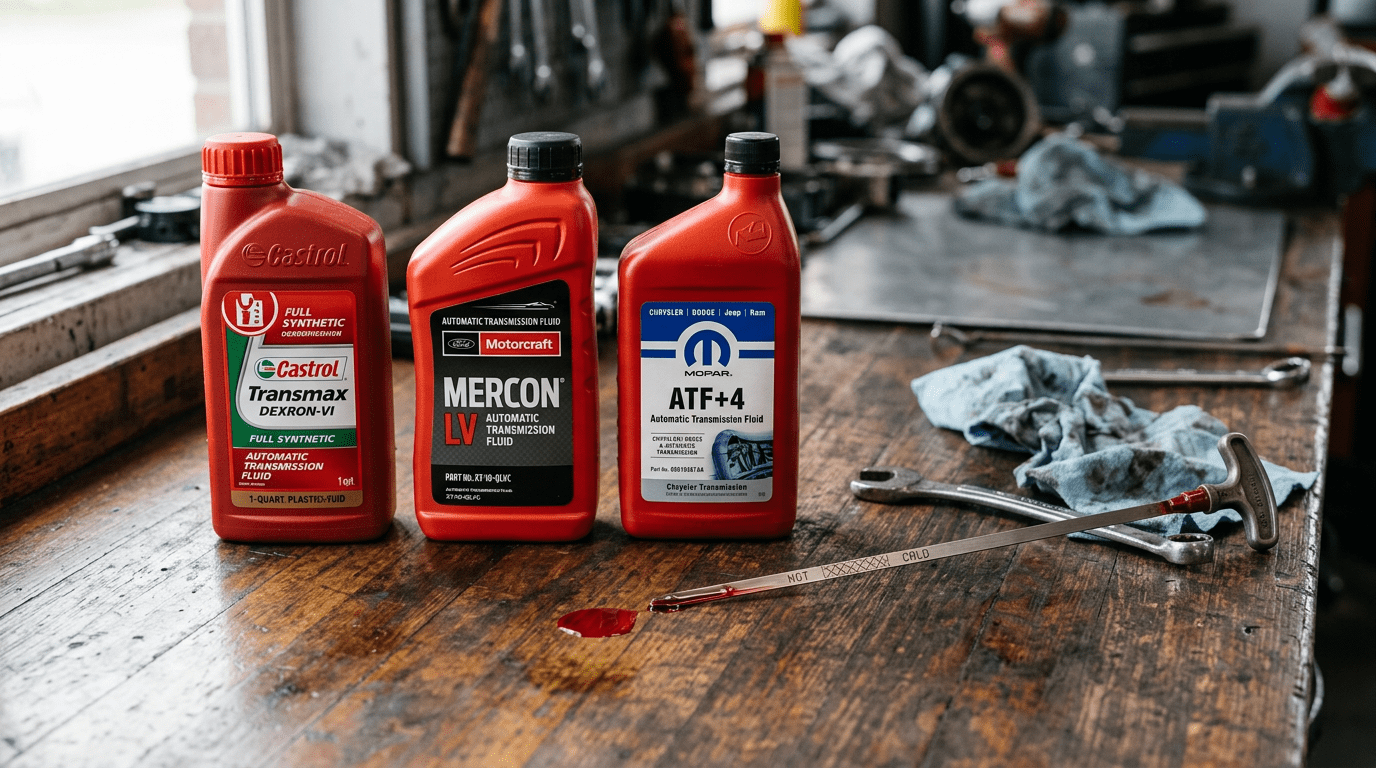
ATF Type Guide
Select an automatic transmission fluid type to see its brand origin, compatible transmissions, and critical cross-compatibility notes.
ATF Type Guide
Select a fluid spec to view brand, compatibility, and notes
How It Works
Each ATF specification is formulated with a specific base oil viscosity grade and friction-modifier additive package designed for the clutch materials and valve body tolerances in that family of transmissions. Using the wrong fluid changes shift feel immediately and can cause accelerated wear within a few thousand kilometres.
How to Use This Calculator
- Select the ATF specification listed in your owner’s manual or on the transmission dipstick.
- Click Show Details to see the brand origin, compatible transmissions, and cross-compatibility notes.
- Verify your transmission model matches the listed applications before purchasing.
- If your spec is not listed, contact your dealership or use an OEM-sourced service manual.
- When in doubt, use the OEM-branded fluid — aftermarket “equivalent” claims vary in accuracy.
Worked Example
Reference Table
| Spec | Origin | Viscosity Grade | Typical Applications | Mix with Others? |
|---|---|---|---|---|
| Dexron III | GM | Dex III (higher) | Older GM 4L60E, 4L80E | Yes — Dexron VI backward-compatible |
| Dexron VI | GM | Low-viscosity synthetic | Modern GM 6/8/10-speed | Replaces III; do NOT use III in VI units |
| Mercon V | Ford | Medium viscosity | 4R70W, 5R55W (older Ford) | No — not Mercon LV compatible |
| Mercon LV | Ford | Low-viscosity synthetic | 6R80, 10R80 (modern Ford) | No — do not sub Mercon V |
| ATF+4 | Chrysler | Unique additive | Jeep/Dodge/Ram automatics | No — unique friction modifiers |
| Toyota WS | Toyota | Very low viscosity | Toyota U-series 2004+ | No — not Dexron/T-IV compatible |
| JWS 3309 | Aisin | Low viscosity | Aisin 6/8-speed, BMW variants | OEM-equivalent only |
| Nissan Matic-K | Nissan | Medium viscosity | RE4R, RE5R05A, 7-speed RE7 | No — Nissan-specific |
| Nissan Matic-J/S | Nissan / Jatco | CVT-specific | Jatco JF010E, JF011E CVTs | CVT only — never regular ATF |
Frequently Asked Questions
Can I use a universal ATF in place of a specific OEM spec?
“Universal” ATFs claim compatibility with Dexron III, Mercon V, and similar older specs. They are generally acceptable for older transmissions where those specs apply. However, modern low-viscosity specs (Dexron VI, Mercon LV, Toyota WS) and brand-specific formulas (ATF+4, Nissan Matic) are not safely replaced by universals. The friction modifier chemistry must match the clutch plate material exactly.
How often should ATF be changed in an automatic transmission?
Modern full-synthetic ATF in a sealed transmission is often rated “lifetime fill” by manufacturers, but many independent mechanics recommend changing it every 60,000–100,000 km. Hard use (towing, mountain driving, hot climates) degrades ATF faster. A dark brown or burnt-smelling fluid with metal particles is overdue for a change regardless of mileage.
What happens if I use the wrong ATF in my transmission?
The wrong viscosity grade alters clutch apply pressure and shift timing, causing harsh or slipping shifts. The wrong friction-modifier chemistry changes clutch engagement feel and accelerates clutch-plate glazing. In CVTs, using regular ATF instead of CVT fluid causes belt/chain slip almost immediately and can cause catastrophic belt failure.
Is it safe to top up ATF if I am unsure of the current fluid type?
If you need to top up a small amount (under 0.5 L) and cannot determine the current fluid, use the OEM-specified fluid. A small amount of the correct fluid diluting an unknown fluid is far safer than adding an incorrect spec. If the level is very low, drain and refill with the correct OEM spec fluid after checking for leaks.