Air-Fuel Ratio Calculator
Convert between AFR and Lambda, and check stoichiometric targets for petrol, E85, and diesel tuning.
AFR / Lambda Converter
AFR ⇄ Lambda for petrol, E85, diesel
How It Works
Lambda (λ) is a normalized AFR where 1.0 = stoichiometric. Lambda = AFR ÷ Stoichiometric AFR. It allows comparison across different fuel types on a common scale.
How to Use This Calculator
- Enter your AFR or Lambda value from your wideband O2 sensor or ECU data.
- Select whether you are entering AFR or Lambda.
- Select the fuel type — this determines the stoichiometric reference.
- Click Convert — Lambda, AFR, and mixture quality appear.
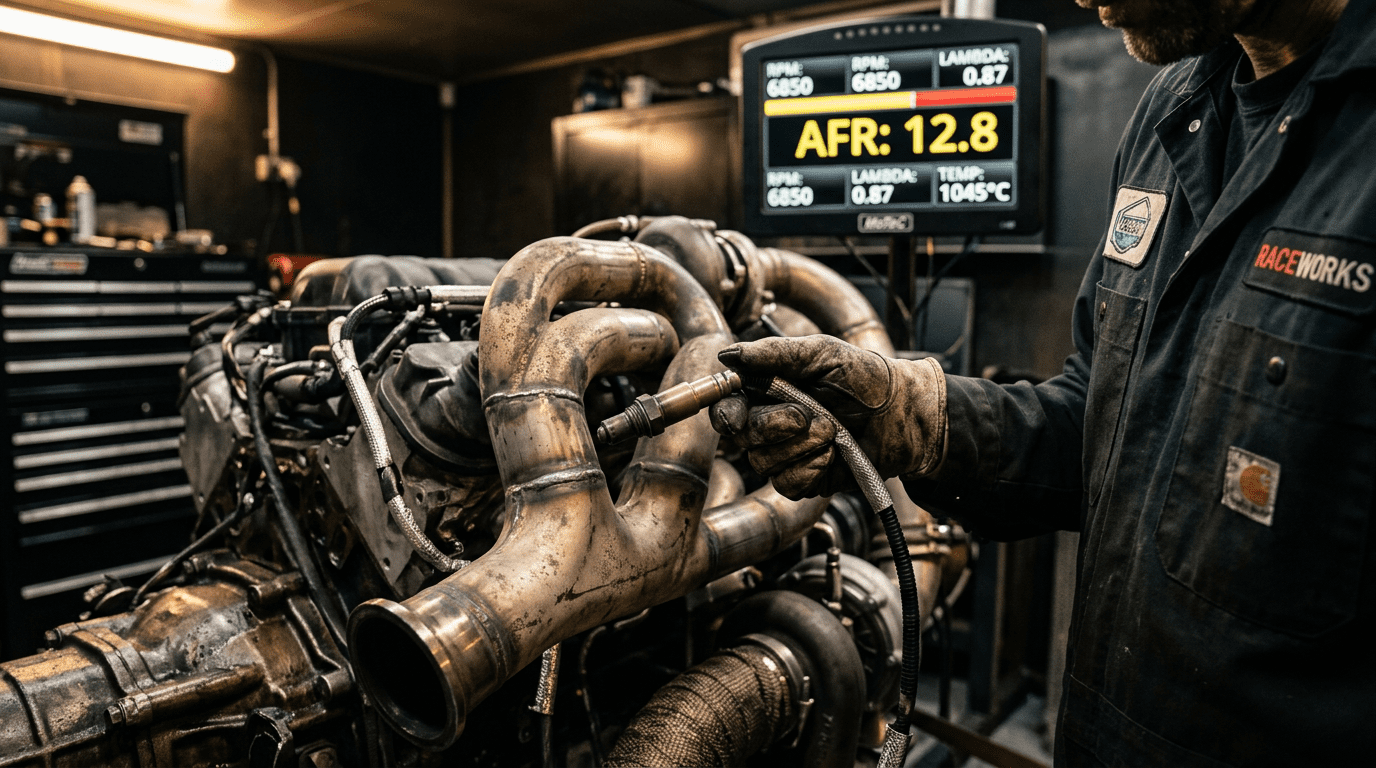
- Lambda < 1.0 = rich; > 1.0 = lean; = 1.0 = stoichiometric.
Worked Example
Reference Table
| Lambda | AFR (Petrol) | Mixture | Application |
|---|---|---|---|
| 0.75 | 11.0:1 | Very rich | WOT max power, cold start |
| 0.85 | 12.5:1 | Rich | Full-throttle power |
| 0.90 | 13.2:1 | Slightly rich | Performance driving |
| 1.00 | 14.7:1 | Stoichiometric | Idle, cruising, catalyst efficiency |
| 1.05 | 15.4:1 | Slightly lean | Light load fuel economy |
| 1.20+ | 17.6:1+ | Lean | Very light load, potential misfire risk |
Frequently Asked Questions
Why is stoichiometric the ideal AFR for a catalytic converter?
Three-way catalytic converters work best at lambda = 1.0 — they simultaneously oxidize CO and HC (rich byproducts) and reduce NOx (lean byproduct). The narrow operating window around stoich is why modern ECUs use a closed-loop O2 feedback strategy.
What lambda target gives maximum power?
Maximum power is typically achieved at lambda 0.85–0.90 (AFR 12.5–13.2:1 on petrol). The rich mixture provides extra fuel to absorb combustion heat, preventing knock and cooling the combustion chamber.
Why does E85 have a different stoichiometric AFR?
Ethanol (C₂H₅OH) has oxygen in its molecular structure, requiring less atmospheric oxygen for complete combustion. E85 (85% ethanol) has a stoichiometric AFR of approximately 9.76:1 vs petrol’s 14.7:1.
What is a wideband O2 sensor and why is it needed for tuning?
A narrowband O2 sensor only tells you rich or lean relative to stoich. A wideband sensor provides a precise lambda reading across the full range (0.65–1.6+), essential for performance tuning and emissions calibration.