Air & Cabin Filter Life Tracker
Track miles since your last engine air filter and cabin air filter change and predict when both are due. Cabin filters affect air quality and AC performance; engine filters affect fuel economy and engine wear.
Air & Cabin Filter Schedule
Plan filter replacements by driving environment and allergy needs.
How It Works
Air filter restriction grows roughly linearly with miles in clean climates and exponentially in dusty environments. Cabin filters trap pollen and PM2.5; engine filters trap dust and debris. Both starve their target system when clogged — cabin filter clogs reduce AC airflow by 30–50%; engine filter clogs cost 1–2 MPG.
How to Use This Calculator
- Record your last filter change mileage (look up old service receipts or default to 30 000 mi ago if unknown).
- Enter your typical driving environment.
- The calculator returns remaining life for both filters.
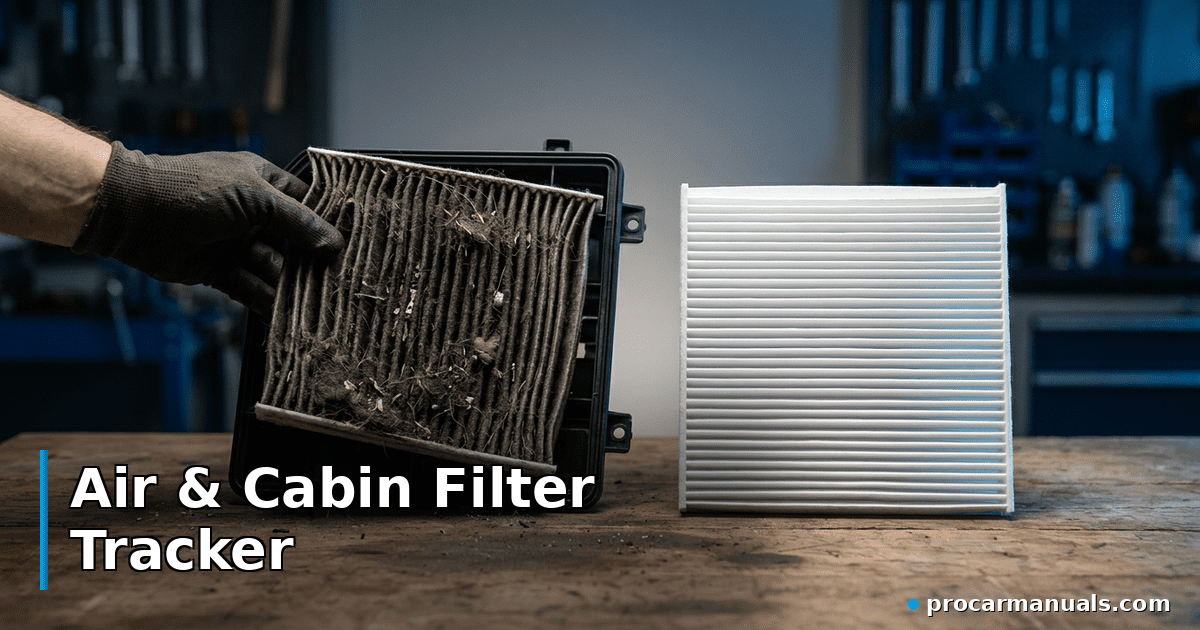
- Visually inspect: if the filter is dark gray or has visible debris, replace regardless of mileage.
Worked Example
Reference Table
Replacement intervals by filter type and environment. K&N and similar reusable filters require cleaning + oiling at the interval shown.
| Filter type | Highway / clean | Mixed urban | Dusty / pollen-heavy |
|---|---|---|---|
| Engine paper | 20 000 mi | 15 000 mi | 8 000 mi |
| Engine cotton (K&N) | 50 000 mi (clean) | 30 000 mi | 15 000 mi |
| Cabin pollen | 15 000 mi | 10 000 mi | 5 000 mi |
| Cabin HEPA / carbon | 25 000 mi | 15 000 mi | 8 000 mi |
Frequently Asked Questions
Will a dirty air filter reduce MPG?
Modern fuel-injected engines lose less MPG to dirty filters than carbureted engines did. Expect 1–2% MPG loss with a moderately clogged filter, up to 5% with a severely clogged one.
Where is my cabin air filter located?
Most common: behind the glove box (drop the glove box, pull the filter sideways). Less common: under the dash or under the windshield cowl. YouTube has a how-to for every model.
Are aftermarket K&N reusable filters better than OEM?
K&N filters flow more air but trap less dust. On most street engines the airflow gain is unmeasurable. They're worth it on track-day cars and trucks in dusty off-road conditions.
Does cabin filter affect AC cooling?
Yes — a clogged cabin filter restricts airflow through the evaporator, reducing cooling capacity and causing the blower motor to work harder. Replacement often "fixes" weak AC.
Can a dirty engine air filter damage the engine?
Only if it tears or fails completely, letting dust into the cylinders. A normal clogged filter just chokes airflow.