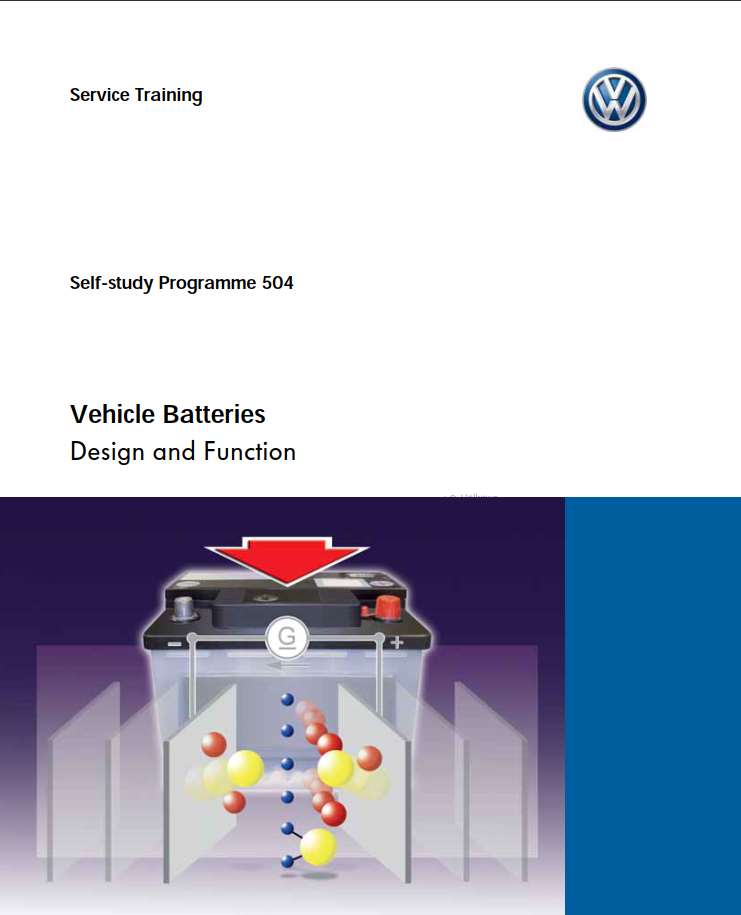
This comprehensive 44-page PDF file contains the official VAG Self-Study Program 504 (SSP 504), focused entirely on the design, function, and maintenance of modern vehicle batteries. In the modern automotive era, a battery must do much more than simply start the engine. With the introduction of complex energy management systems, regenerative braking, and Start-Stop technology, the 12-volt battery has become a critical, highly stressed component of the vehicle’s electrical network. This technical training manual is an absolute must-have for VAG technicians, diagnostic specialists, and service advisors who need to understand which battery types are appropriate for specific vehicle applications and how to properly test them.
Please note: As a foundational Self-Study Program, this document focuses on chemical theory, battery construction, and general maintenance principles rather than model-specific wiring diagrams.
This detailed technical training manual covers the following key electrical topics:
- Chemical Principles and Battery Theory: A deep dive into how a battery stores and releases energy. It explains the chemical reactions of lead, lead dioxide, and sulfuric acid during both the charging and discharging phases, as well as the effects of temperature on battery capacity and cold cranking amps.
- Battery Types and Construction: The core of the manual. It provides a complete breakdown of the physical differences between various battery technologies used by Volkswagen Group. It meticulously details standard flooded Lead-Acid batteries, Enhanced Flooded Batteries (EFB) designed for entry-level Start-Stop systems, and advanced Absorbent Glass Mat (AGM) batteries required for vehicles with high electrical loads and regenerative braking.
- Energy Management Integration: An overview of how modern VAG vehicles monitor battery health. It explains the function of the battery sensor (which measures current, voltage, and temperature) and why it is absolutely critical to use a diagnostic tool to “code” or “adapt” a new battery to the vehicle’s energy management control module upon replacement.
- Diagnostics, Testing, and Safety: Essential reading for the workshop. It outlines the proper procedures for testing battery health (using specific conductance or electronic testers), the rules for safe jump-starting, and the correct methods for charging EFB and AGM batteries without causing internal damage.
Whether you are trying to understand why an AGM battery cannot be replaced with a standard lead-acid unit, diagnosing a persistent parasitic drain, or need to know the correct procedure for coding a new battery using VCDS or ODIS, SSP 504 is the definitive technical resource.
CONTENTS
- Introduction
- Historical details
- Batteries yesterday, today and tomorrow
- The basics
- Battery design
- Sulphuric acid
- Charging and discharging processes
- Technical variables and terms
- Battery types
- Wet batteries
- Good value batteries (economy batteries)
- Enhanced flooded batteries (EFB)
- Absorbent glass mat batteries (AGM batteries)
- VOLKSWAGEN batteries
- Effects on energy management
- Vehicle electrical system concepts
- Battery and alternator interaction
- Discharge and temperature response
- Service
- Battery check
- Charging the battery
- Jump starting
- Battery – operation
- Infosheet on handling starter batteries
- Dangers when handling batteries
- Glossary
- Test your knowledge
Language: English
Format: PDF
Pages: 64
Self Study Program 504 – Vehicle Batteries Design and Function PDF free online