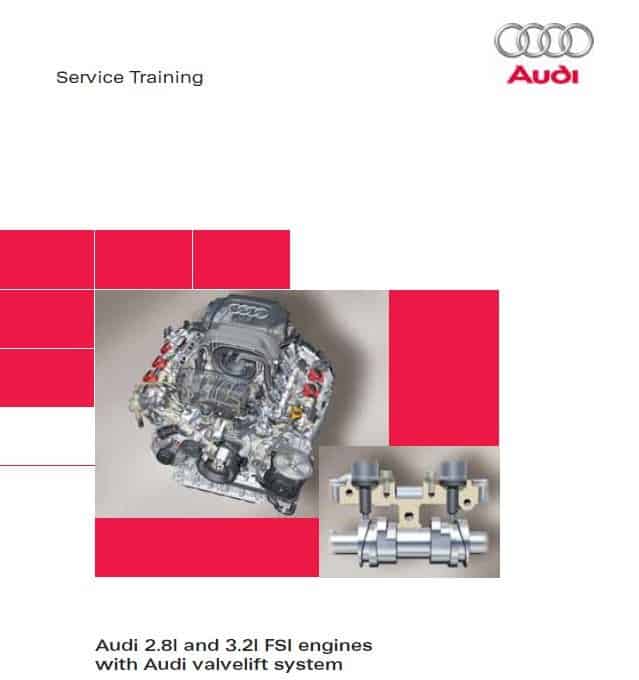
CONTENTSThis comprehensive 64-page PDF file contains the official VAG Self-Study Program 411 (SSP 411), focused entirely on the development and mechanical function of the heavily revised Audi 2.8-liter and 3.2-liter V6 FSI engines. Developed to replace older MPI engines and improve upon the existing V6 architecture, these engines were explicitly engineered with one primary goal: significantly reducing internal friction and lowering fuel consumption. To achieve this, Audi engineers introduced several major technological advancements, most notably the Audi valvelift system (AVS). This technical training manual is an absolute must-have for VAG technicians, diagnostic specialists, and mechanics maintaining modern V6 Audis.
Please note: As a Self-Study Program, this document focuses heavily on engineering design, structural layouts, and operational theory. It is not a step-by-step rebuild or workshop manual, though the theoretical knowledge it provides is crucial for diagnosing complex variable valve timing or oil pressure faults.
This detailed technical training manual covers the following key engineering topics:
- Engine Mechanics and Friction Reduction: A deep dive into the physical construction of the aluminum cylinder block. It meticulously details the modifications made to reduce parasitic drag, including lowering piston ring tension, switching the high-pressure fuel pump drive from a bucket tappet to a roller tappet, and adopting roller chains for the timing system.
- The Audi Valvelift System (AVS): The core focus of the manual. It provides a complete, step-by-step breakdown of how AVS operates. It explains the use of sliding cam pieces (cam units) on the intake camshafts, which are shifted electromagnetically by metal pins to switch between a small cam profile (for partial load) and a large cam profile (for full load), drastically improving engine breathing.
- Advanced Timing Chain Drive: Essential reading for understanding engine timing. It details the new chain layout and the introduction of “tri-oval” (slightly triangular) chain sprockets designed specifically to counteract the pulsating tension forces within the chain drive, further reducing friction and wear.
- Volume-Flow-Controlled Oil Pump: A complete look at the engine’s new dual-stage lubrication system. It thoroughly explains the operation of the map-controlled oil pump, which switches between a low-pressure and high-pressure stage depending on engine load, reducing the parasitic power draw of the pump.
- Engine Management (Simos 8.1): An overview of the specific electronic management system required to coordinate the AVS actuators, the direct fuel injection, and the two-stage oil pump.
Whether you are trying to map the flow of the complex tri-oval timing chain system, diagnosing a fault with the electromagnetic AVS actuators, or researching the exact operation of the dual-stage oil pump, SSP 411 is the definitive technical resource.
- Specifications
- Engine mechanicals
- Engine block
- Crank mechanism
- Crankcase ventilation system
- Crankcase air intake system
- Cylinder head
- Audi valvelift system
- Chain drive
- Actuation of ancillary units
- Oil circulation system
- Lubrication system
- Design
- Oil pump
- Oil level indicator
- Cooling system
- Engine cooling system
- Air circulation system
- Overview
- Throttle valve control unit J338
- Variable intake manifold
- Vacuum hose assembly
- Fuel system
- Low/high pressure system
- Exhaust system
- Exhaust system
- Engine management
- System overview for the 2.8l FSI engine
- Service
- Special tools
Language: English
Format: PDF
Pages: 64
Self Study Program 411 – Audi 2.8l and 3.2l FSI engines with Audi valvelift system PDF free online