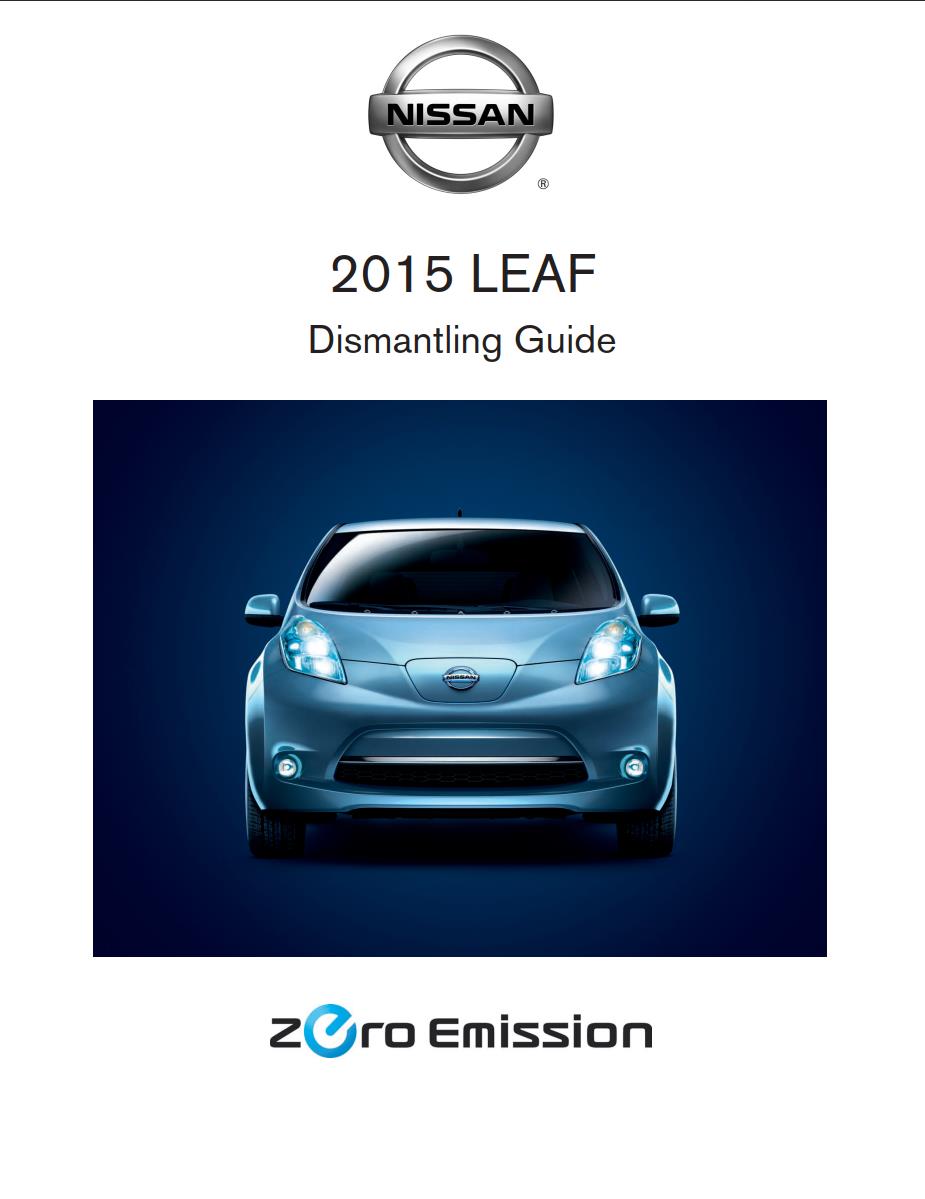
The Nissan LEAF 2015 Dismantling Guide is the official factory manual that describes safe dismantling operations and related warnings for the all-electric Nissan LEAF, which is equipped with a high-voltage Lithium-ion (Li-ion) traction battery. Designed for professional dismantlers, salvage yards, and emergency responders, this guide explains how to identify, de-energize, and safely disassemble the vehicle to prevent electrical shock, injury, or death from improper handling.
What’s Inside
- About the Nissan LEAF – exterior and interior identification (no tail pipe, plastic underside shields, charging indicator lights, power switch, READY indicator, charge connector lock switch), VIN layout (5th character “Z” indicates an electric vehicle), and warning/indicator lamp information including the EV System Warning Lamp and master warning lamps.
- Basic High Voltage Information – locations and descriptions of high-voltage and 12 V components: charge port, orange high-voltage cables, traction motor, inverter, electric A/C compressor, Power Delivery Module (PDM) with on-board charger and DC/DC converter, high-voltage junction box, 12 V battery, cabin heater, Li-ion battery, service disconnect, and brake power supply backup unit.
- Li-ion Battery Pack Specifications – 360 V nominal (240 V–398.4 V usable), 48 modules, dimensions 1547 × 1188 × 264 mm, weight 275 kg (606 lbs).
- High Voltage Safety Measures – circuit insulation, orange covering and warning labels, and three shut-off methods: service plug, system main relay, and emergency shut-off system (triggered by airbag deployment or system malfunction).
- Preparation for Dismantling – discharging procedures (using headlamps, cabin heater, defroster to drop the charge gauge below half), required Personal Protective Equipment (1,000 V insulated gloves, shoes, safety shield, solvent-resistant gear), and 1,000 V/300 A insulated tools.
- High Voltage System Shut-Down Procedures – three options: Primary Procedure (turn off power switch + disconnect 12 V negative), Alternate Procedure 1 (remove F24 FS1 RLY 15 A, F3 VCM 20 A and 20 A VCM fuses), and Alternate Procedure 2 (remove the service plug behind the center console), all followed by a mandatory 10-minute capacitor discharge wait and a 3-minute SRS airbag discharge wait.
- Cutting the Vehicle Body – SRS airbag system component locations (crash zone sensor, front/side/curtain airbag modules and inflators, satellite sensors, seat-belt pretensioners, ACU) and the official vehicle cut sheet showing “NEVER CUT” zones for the Li-ion battery and orange high-voltage harnesses.
- Special Conditions – procedures for water-submerged vehicles, vehicle fires (use large amounts of water from a hydrant or Type ABC extinguisher), and Li-ion battery damage/electrolyte leaks (clear, sweet-smelling, flammable solution that irritates skin, eyes, and respiratory system).
- Jump Starting & P-Park Release – step-by-step 12 V jump-start procedure (the high-voltage Li-ion battery cannot be jump-started), and the two-person P (Park) position release using the FL 40 A PBW MTR and METER 10 A fuses.
- Storing the Vehicle – requires removing the service plug and posting an EV/high-voltage warning sign; do not store indoors, and keep away from other vehicles if the Li-ion battery is severely damaged due to delayed-fire risk.
- Li-ion Battery Pack Removal & Recycling – exploded view (battery pack, bonding plates, front/center/rear undercovers, mounting brackets), the full removal procedure using a pallet and lift table, and contact information for Nissan-certified LEAF dealers for recovery and recycling of the fully recyclable high-voltage battery.
Emergency Contacts
- Nissan EV Customer Support: 1-877-664-2738
- Nissan Consumer Affairs: 1-800-647-7261 (US) / 1-800-387-0122 (Canada)
This guide is essential reading for any technician, recycler, or first responder working with a 2015 Nissan LEAF, ensuring the high-voltage system is properly de-energized before any cutting, fuse removal, service-plug extraction, or battery-pack disassembly is performed.
Language: English
Format: PDF